
Introduction: The Unified Engineering Stack: Master the Tools That Drive Global Industry
The engineering industry is undergoing a silent, tectonic shift. For decades, the professional landscape was governed by rigid silos: the civil engineers lived in their drafting rooms, mechanical engineers focused on moving parts, and electrical engineers obsessed over circuits. But after 18 years of navigating high-stakes environments—from the skyline of Dubai to the complexities of 132kV grid stations in Pakistan—I have learned a hard, unavoidable truth: The industry no longer rewards the siloed specialist. It rewards the Engineering Strategist.
Modern construction and industrial automation projects are becoming increasingly complex. When a grid station fails, or a luxury tower faces mechanical delays, it is rarely because a single team lacked technical skill. It is because the data—the lifeblood of the project—stayed in silos.
If you want to build a career that is resilient, high-paying, and globally mobile, you must move beyond the degree. You must master the Unified Engineering Stack.
I. The Death of the Silo: Why You Must Become a Strategist
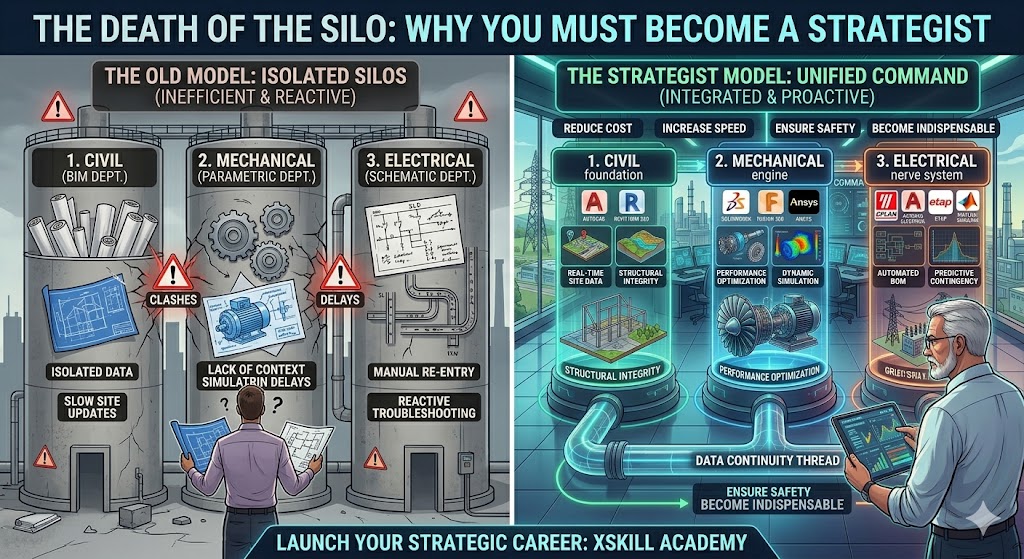
In the traditional model, a project begins with a blueprint, passes through a “handoff” to mechanical, and finally hits the electrical desk for power distribution. If the electrical team discovers a physical constraint that clashes with the civil layout, the project stalls. Manual rework, costly delays, and finger-pointing become the norm.
An engineering strategist doesn’t wait for these clashes. By mastering the unified stack, you become the architect of the entire data flow. You understand how the BIM model dictates the tray layout, how the mechanical load informs the transformer capacity, and how your electrical simulations prove the system’s safety before the first conduit is even bent.
II. The Three Pillars of the Unified Stack
To command the project, you must first master the individual pillars of modern engineering.
Pillar 1: The Civil Foundation (BIM & Digital Twin)
Civil engineering is the “physical context” of every project. In the era of Building Information Modeling (BIM), you are not just drawing 2D plans; you are building a database of materials, spaces, and constraints.
-
The Command Strategy: Use AutoCAD and Revit/BIM 360 to create a living “digital twin” of your site. If your civil model accurately maps cable routes and floor loadings, your electrical and mechanical teams are no longer guessing; they are designing within a validated reality. For a deep dive into this approach, explore our Civil Engineering Tools Guide.
Pillar 2: The Mechanical Engine (Motion & Efficiency)
Mechanical systems provide the “work” for the infrastructure. Whether it’s HVAC in a tower or pump stations in a canal, your design must prioritize efficiency.
-
The Command Strategy: Master parametric modeling with SolidWorks. By modeling components with dynamic properties, you can simulate heat dissipation and stress factors, ensuring your designs don’t just “work on paper” but survive the harsh realities of site operation. Learn more about the necessary mechanical engineering tools to get started.
Pillar 3: The Electrical Nerve System (Logic & Safety)
This is the heart of the project. It integrates the logic that drives the mechanical movement and supports the civil infrastructure.
-
The Command Strategy: EPLAN and AutoCAD Electrical are your drafting powerhouses, but ETAP and MATLAB are your decision-making tools. A strategist doesn’t just draw a schematic; they run a contingency simulation. If the main busbar faults, does your relay coordination prevent a catastrophic blackout?
III. The Bridge: Establishing Data Continuity
True mastery lies in the “Data Thread”—the ability to pass information across these pillars without loss or error.
1. Field-to-Office: The Site Audit
Amateurs design from memory; pros design from data. When you walk a site, use mobile tablets to capture high-resolution imagery. Import these as a reference layer in your CAD software. When your new layout perfectly aligns with the physical reality, you eliminate field clashes. Check out our site development resources to master this.
2. The Automated BOM (Bill of Materials)
Manual re-entry is where projects bleed money. If your CAD software isn’t talking to your procurement spreadsheets, you are wasting hours. Create a centralized data schema where your design components are automatically logged. This ties directly into the project management principles that define high-impact careers.
IV. The Lead Strategist Mindset
Beyond software, you must cultivate the mindset of a leader.
-
Reverse-Engineering as Training: Do not wait for a formal course. Find a functional industrial control panel, strip it down, and recreate its wiring diagram. Simulate its logic. If it works virtually as it does in the real world, you have truly mastered the tool.
-
The Documentation Test: Your drawings are your product. If a technician at 2:00 AM cannot fix a fault because your technical analysis documentation is unclear, you have failed.
-
Financial Literacy: The most valuable engineer is the one who understands how their design affects the bottom line. Learn the cost of copper, the lead time on transformers, and the cost of site labor.
V. Launching Your Career via Xskill Academy
The digital era has removed the gatekeepers. You do not need a piece of paper to be a high-impact designer; you need a portfolio of field-ready deliverables.
At Xskill Academy, we focus on the Unified Stack approach. We don’t teach you how to draw circles; we teach you how to manage the “command” of a multi-domain project. Whether you are a student, a career-changer, or a veteran engineer looking to modernize, the Career Path Engineering roadmap is clear.
Conclusion: Your Roadmap to Mastery
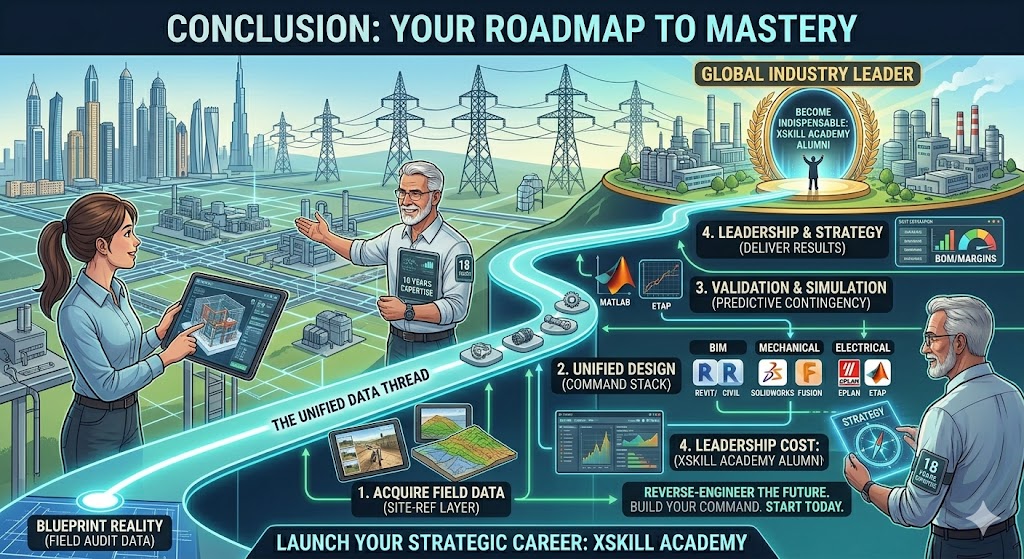
The tools are at your fingertips. The industry is waiting for people who can solve problems, not just people who hold degrees. The “Engineering Command” is not something you are born with—it is something you build, layer by layer, through discipline and curiosity.
Start today. Download the student versions of these tools, pick a real-world system, and start building your stack. The project manager of tomorrow isn’t waiting for a promotion; they are building the command center themselves.
Are you ready to stop designing in a vacuum and start building a high-impact global career? Join us at Xskill Academy, and let’s bridge the gap from blueprint to site reality together.
Ready to power your career? Download my full engineering career roadmap here