
Stylish Design: The 10 Construction Technologies Defining the Future of Engineering: A Strategist’s Guide for 2026
In an era where innovation meets necessity, the construction industry is undergoing a radical transformation. As we approach 2026, the integration of cutting-edge technologies is not just an option; it is imperative for survival and success. This guide outlines the ten pivotal technologies that every strategist must embrace to lead the charge in modern engineering.
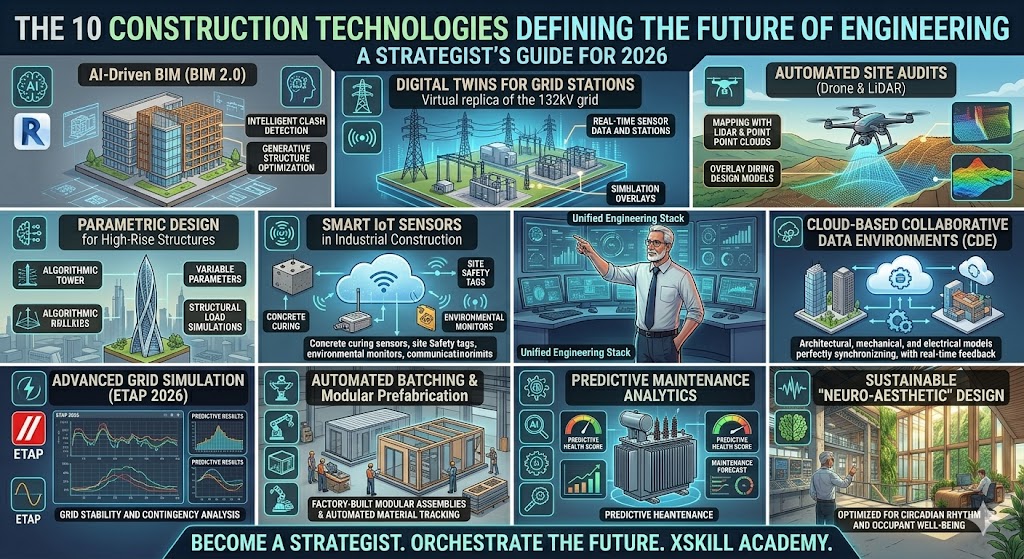
- AI-Driven BIM (Building Information Modeling 2.0)
- Digital Twins for Grid Stations
- Automated Site Audits (Drone & LiDAR Scanning)
- Parametric Design for High-Rise Structures
- Smart IoT Sensors in Industrial Construction
- Cloud-Based Collaborative Data Environments (CDE)
- Advanced Grid Simulation (ETAP 2026)
- Automated Batching & Modular Prefabrication
- Predictive Maintenance Analytics
- Sustainable “Neuro-aesthetic” Design
Digital Twins for Grid Stations
As we delve into each technology, it becomes clear that the future of construction is not merely about building structures; it is about creating intelligent ecosystems that enhance efficiency, safety, and sustainability. Embrace these innovations, and position yourself at the forefront of the engineering revolution.
The construction industry is no longer about moving concrete; it is about managing data. As a Lead Strategist with 18 years of experience, I’ve seen the shift from manual drafting to AI-driven orchestration. To dominate the industry in 2026, you must stop being a “tool user” and start being a “system architect.” Here are the 10 technologies defining our future.
1. AI-Driven BIM (Building Information Modeling 2.0)
Building Information Modeling has evolved from a 3D drafting exercise into a living, intelligent database. In my early years, we manually checked for clashes between electrical trays and HVAC ducts. Today, AI-driven BIM detects these spatial conflicts in real-time before the foundation is even poured.
As a strategist, you shouldn’t just model; you should simulate. By integrating AI, the software now suggests structural optimizations based on site-specific constraints, such as wind loads or soil bearing capacity. This isn’t just about saving time; it’s about risk mitigation. When you can foresee a structural clash from your BIM integration dashboard, you save your client millions in potential rework. My pro tip? Never approve a site plan that hasn’t been run through an AI collision detection module. It’s the difference between a project that runs smoothly and one that bleeds budget.
-
Internal Link: Learn more about BIM integration here.
-
External Link: Explore Autodesk’s AI-powered construction tools.
2. Digital Twins for Grid Stations
In the world of high-voltage transmission, downtime is not an option. A Digital Twin is a virtual replica of a physical asset, synced with real-time sensor data. During my time managing 132kV grid stations, I realized that reactive maintenance is a death sentence for project margins.
With a digital twin, you are not just building a structure; you are creating a diagnostic hub. You can monitor transformer temperatures, vibration, and load profiles from a remote office. If a circuit breaker begins to show signs of mechanical fatigue, the system alerts you long before a failure occurs. This proactive approach is what separates a site engineer from a lead strategist. By mastering this technology, you provide your clients with a “predictive maintenance” plan that extends the lifecycle of their infrastructure by years.
-
Internal Link: Deep dive into professional grid station design.
3. Automated Site Audits (Drone & LiDAR Scanning)
Manual site surveys are slow, prone to human error, and expensive. In 2026, if you aren’t using LiDAR or drone-based photogrammetry, you are operating at a massive disadvantage.
In my experience, walking a large-scale project site to manually record topographic variations or obstacle coordinates takes days. With drone scanning, I can capture a high-precision point cloud of a 50-acre site in less than an hour. This data serves as the “reference layer” for your CAD environment. When your design is anchored to a millimeter-accurate digital survey, your on-site execution becomes flawless. Integrating this into your Site Development workflow is the first step toward true data continuity. It ensures that the digital design matches the physical reality—a prerequisite for any successful high-impact project.
-
Internal Link: Mastering site development protocols.
4. Parametric Design for High-Rise Structures
Parametric design is the art of using algorithms to define design constraints. Instead of drawing a building, you define the “rules” of the building. When I worked on a 72-story luxury tower in Dubai, we used parametric modeling to optimize the building’s orientation to maximize natural lighting while minimizing heat gain.
This technology allows you to test thousands of variations in minutes. If the client decides to add five extra floors, you don’t redraw the tower—you update the parameters, and the model recalculates structural loads and material requirements instantly. This level of agility is exactly what Modern Engineering requires. As a strategist, you aren’t just designing aesthetics; you are using mathematics to ensure structural performance. It turns complex architectural visions into buildable, efficient, and safe engineering projects.
-
Internal Link: Explore more modern engineering trends here.
5. Smart IoT Sensors in Industrial Construction
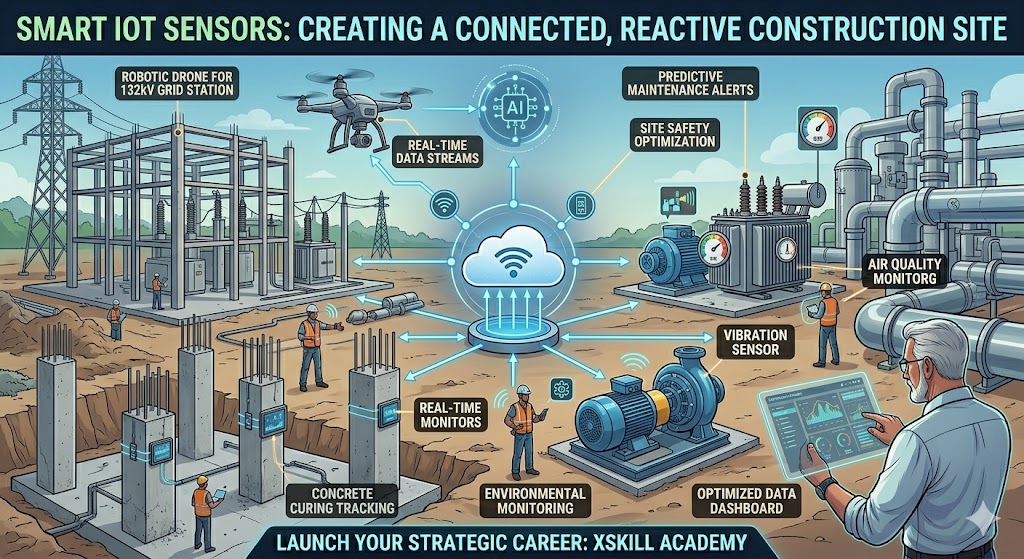
The “Internet of Things” (IoT) has brought unprecedented visibility to the construction site. By embedding sensors in concrete foundations, steel beams, and temporary structures, you gain a constant stream of data regarding environmental conditions and structural integrity.
I’ve seen projects delayed by weeks because someone “guessed” that the concrete had cured sufficiently. With IoT, you know precisely when the chemical reaction is complete, saving days of guesswork. Beyond curing, these sensors track safety parameters—detecting gas leaks or hazardous vibrations in real-time. This is about taking control of the Project Management process. When you have live data on every aspect of your site, you eliminate the “black box” of construction. You become the manager who makes decisions based on hard data rather than assumptions.
-
Internal Link: Read more about advanced project management.
6. Cloud-Based Collaborative Data Environments (CDE)
A project dies the moment the teams stop communicating. In the past, we relied on physical “transmittal” folders and emailed ZIP files. Today, a Common Data Environment (CDE) is the heart of the project.
In my “Unified Engineering Stack,” the CDE is where the Civil, Mechanical, and Electrical teams meet. If the electrical team updates a cable trench depth, the civil team sees the change in their model instantly. This prevents the “I didn’t know” excuse that ruins schedules. Using a CDE creates a single source of truth for the entire lifecycle of the build. It ensures that every stakeholder—from the site supervisor to the project owner—is looking at the same reality. It is the most effective tool for Technical Analysis and interdisciplinary coordination.
-
Internal Link: Mastering technical analysis for construction.
7. Advanced Grid Simulation (ETAP 2026)
For electrical engineers, ETAP is the gold standard for grid stability analysis. It is not just about drawing a single-line diagram; it is about predicting how the system will react under extreme stress, such as harmonic distortion or short-circuit faults.
In my career, I’ve used simulation to prevent regional blackouts during plant commissioning. If your relay coordination logic isn’t tested in a robust simulation, you are putting the entire infrastructure at risk. The 2026 version of this software allows for predictive contingency modeling—testing “what-if” scenarios that help us design safer, more resilient grid stations. It’s an essential part of the Career Path Engineering portfolio for anyone wanting to move into high-value power transmission projects.
-
Internal Link: Your full roadmap to a career in engineering.
-
External Link: Learn more about the power of ETAP.
8. Automated Batching & Modular Prefabrication
Construction is shifting away from the chaotic, weather-dependent “site-built” model towards controlled, factory-style modularity. Automated batching plants, where every ounce of material is tracked via software, are ensuring consistency that was impossible a decade ago.
I’ve witnessed how modular prefab construction—where electrical and mechanical modules are built off-site and dropped into the structure—can cut project timelines by 30%. It requires extreme precision in the initial design, but it pays off in efficiency and waste reduction. As a strategist, you must understand how to design for “modular assembly.” It’s about viewing construction as a high-precision manufacturing process rather than a dirty, manual labor task.
-
External Link: Discover the future of modular construction.
9. Predictive Maintenance Analytics
The goal of a great engineer is not just to build something that lasts; it’s to build something that tells you when it needs help. Predictive analytics uses machine learning to analyze performance history and detect anomalies.
Think of it as a doctor for your building or plant. By analyzing variables like power consumption, pressure, and thermal output, you can predict a failure months before it happens. This drastically reduces the cost of emergency repairs and allows for planned maintenance during off-peak hours. For a project owner, this is the highest value an engineer can provide. You are not just delivering a structure; you are delivering an asset that remains profitable and reliable for its entire lifespan.
10. Sustainable “Neuro-aesthetic” Design
Modern construction is finally acknowledging that our environment affects our health. “Neuro-aesthetics” is the study of how the physical design of a space impacts our brain, mood, and productivity.
Today’s engineers aren’t just designing for function; they are designing for “biophilia”—the human need to connect with nature. Using sophisticated software to optimize daylighting, airflow, and acoustics, we create “Modern Sanctuaries.” This is the future of urban development. When you can prove that your building design increases occupant productivity by 10% through light and spatial optimization, you aren’t just an engineer—you are a high-level consultant. This is the ultimate synthesis of industrial technology and human-centric design.
The Era of Biophilic Architecture: Where Industrial Tech Meets the Human Soul
Modern construction has moved beyond the cold, brutalist aesthetic of the past. Today, the most stylish—and successful—projects are defined by “Neuro-aesthetics” and Biophilic Design. This shift focuses on the intersection of high-performance industrial technology and the biological necessity of human connection to nature.
The Biophilic Blueprint
Biophilic design is not just about placing a few potted plants in a lobby. It is the intentional integration of natural light, organic geometry, and sustainable ventilation systems into the very bones of a structure. By using advanced Parametric Design tools, architects can now calculate the exact angle of sunlight entering a room at any hour of the day, ensuring the space supports the human circadian rhythm.
Industrial Soul: The “Warm” Tech Revolution
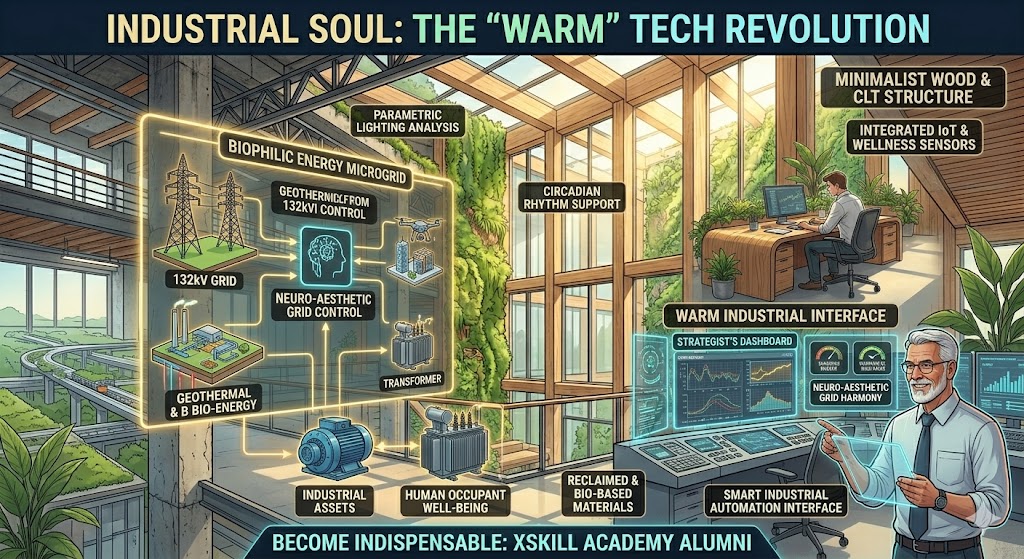
The “stylish” construction of 2026 relies on Smart Industrial Integration. We are seeing a trend where raw industrial elements—exposed steel trusses, reclaimed concrete, and high-tech automation—are softened by warm, natural materials like cross-laminated timber (CLT).
-
The Contrast: High-tech control panels for building automation systems are now being integrated into sleek, minimalist wood-paneled walls.
-
The Goal: To create “Modern Sanctuaries” that look like high-end design boutiques but function with the precision of a power plant.
The Strategist’s Verdict
For the modern Lead Strategist, “style” is a business metric. Buildings that incorporate these wellness-focused technologies command higher rents, retain occupants longer, and offer greater long-term value. When you bridge the gap between hard engineering and human experience, you don’t just build a structure—you build a legacy