




📖 Read time: 12 minutes
🔧 Category: Power Transmission
âš¡ HVDC vs HVAC Guide
Introduction
The global electricity demand continues to rise, and power generation sources are increasingly located far from population centers. Hydroelectric plants in remote mountains, wind farms in offshore locations, and solar parks in deserts all require long-distance transmission to deliver power to cities and industries. This reality has intensified the debate between two competing technologies: High Voltage Direct Current (HVDC) and High Voltage Alternating Current (HVAC).

For decades, HVAC has been the global standard for power transmission. However, HVDC has emerged as a compelling alternative for specific applications, particularly long-distance and submarine transmission. This comprehensive guide examines both technologies in detail, comparing their technical characteristics, efficiency, costs, reliability, environmental impact, and real-world applications. Engineers, project developers, and utility planners will gain practical insights for selecting the optimal transmission technology for their specific needs.
Historical Context: The War of Currents
The rivalry between AC and DC is not new. In the late 19th century, Thomas Edison championed DC while Nikola Tesla and George Westinghouse advocated for AC. AC ultimately won due to its ability to be transformed to high voltages for efficient long-distance transmission and back down to safe levels for consumer use. For over a century, AC remained the undisputed standard.
However, the development of high-power mercury-arc valves in the 1950s, followed by thyristor valves in the 1970s and voltage source converters (VSC) in the 1990s, made HVDC practical and economical for specific applications. Today, both technologies coexist, each serving optimal roles in modern power systems.
Understanding HVAC Transmission
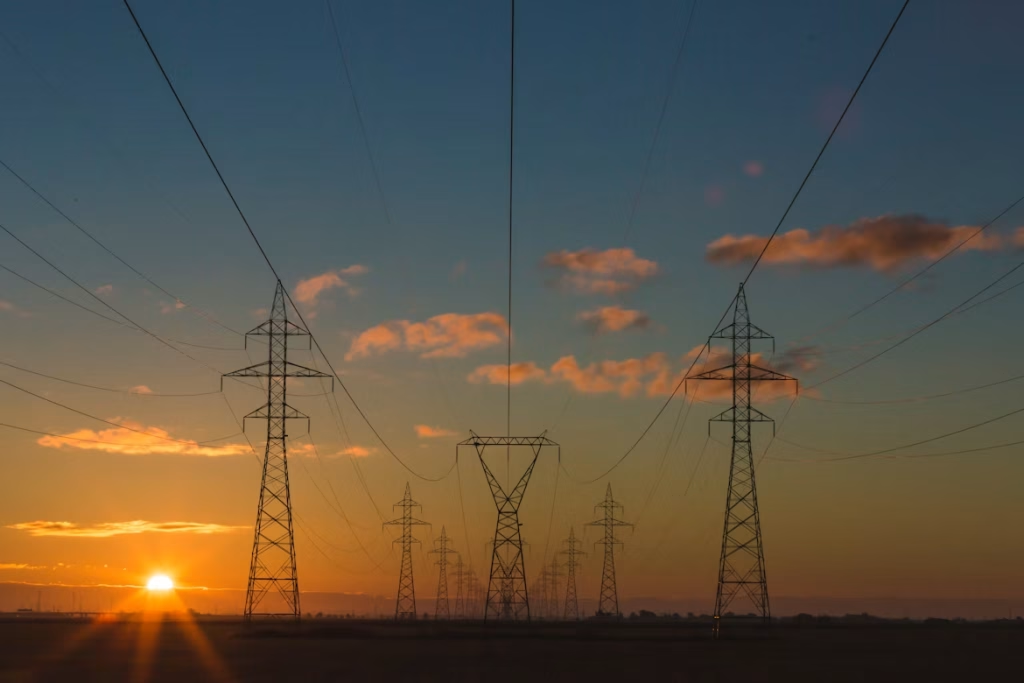
High Voltage Alternating Current (HVAC) transmission is the conventional method of bulk power transfer. In an HVAC system, voltage and current alternate sinusoidally at a fixed frequency (50 Hz or 60 Hz). Typical voltage levels for long-distance HVAC transmission range from 220 kV to 765 kV, with 400 kV and 500 kV being common.
How HVAC Works:
Power plants generate electricity at medium voltage (11-25 kV). Step-up transformers increase the voltage to transmission levels (e.g., 400 kV or 500 kV). The power travels through overhead lines or underground cables to load centers. Step-down transformers then reduce the voltage for distribution to homes and businesses.
Key Technical Parameters of HVAC:
- Voltage levels: 220 kV, 400 kV, 500 kV, 765 kV, and 1200 kV (UHVAC)
- Frequency: 50 Hz (Europe, Asia, Africa, Australia) or 60 Hz (Americas, parts of Asia)
- Typical power transfer: 1,000 to 3,000 MW per circuit (depending on voltage)
- Economical distance: 200 to 500 km without compensation
- Losses: 3-5% per 100 km (including corona and reactive losses)
Major Components of HVAC Systems:
- Transformers: Step-up and step-down voltage transformation
- Transmission lines: Overhead conductors or underground cables
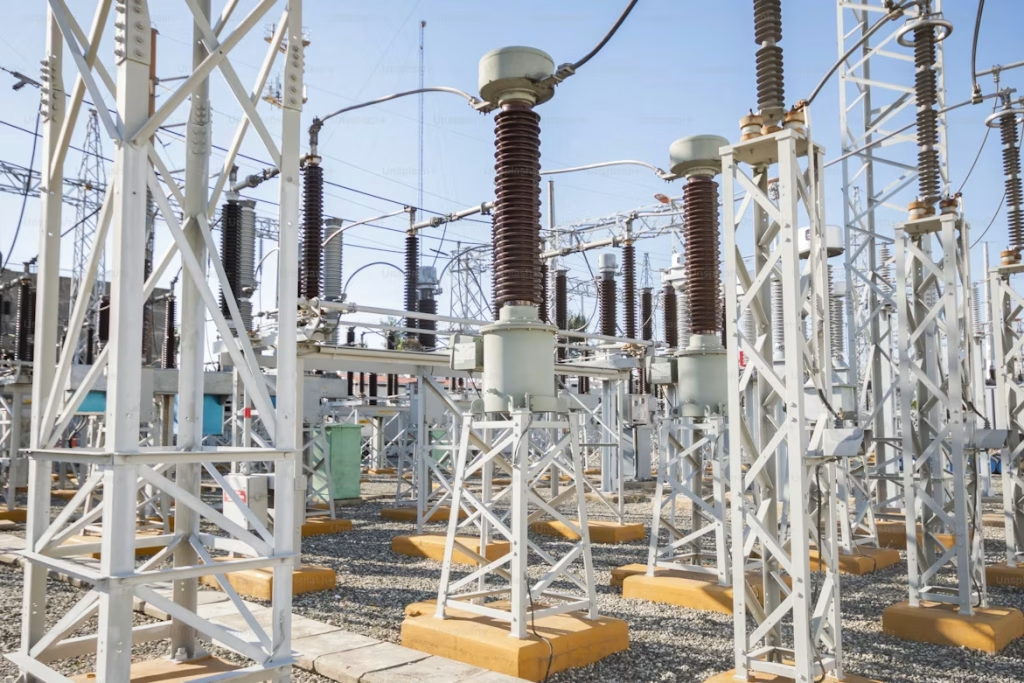
- Substations: Switchgear, circuit breakers, and protection systems
- Reactive compensation: Shunt reactors, series capacitors, STATCOM, or SVC
- Protection systems: Distance relays, differential protection, auto-reclosers
Understanding HVDC Transmission
High Voltage Direct Current (HVDC) transmission uses direct current for bulk power transfer. Unlike HVAC, HVDC has no frequency and does not suffer from reactive power losses or skin effect. HVDC systems require converter stations at both ends to convert AC to DC (rectifier) and DC back to AC (inverter).

Types of HVDC Systems:
- Monopolar HVDC: Single conductor with ground or sea return (up to 1,500 MW)
- Bipolar HVDC: Two conductors (positive and negative polarity) with ground return (2,000-4,000 MW)
- Back-to-Back HVDC: Converter stations located at the same site for asynchronous grid interconnection
- Multi-terminal HVDC: Three or more converter stations connected to the same DC line (emerging technology)
Key Technical Parameters of HVDC:
- Voltage levels: ±200 kV, ±320 kV, ±500 kV, ±800 kV, and ±1100 kV (UHVDC)
- Frequency: Not applicable (DC system)
- Typical power transfer: 500 to 12,000 MW per bipolar line
- Economical distance: 600 to 3,000+ km
- Losses: 3-5% total (including converter losses) per 1,000 km
Major Components of HVDC Systems:
- Converter stations: Rectifier (AC to DC) and inverter (DC to AC)
- Converter transformers: Specially designed for HVDC
- Thyristor or IGBT valves: Semiconductor switching devices
- Harmonic filters: AC and DC filters to reduce harmonic distortion
- Reactive power compensation: Shunt capacitors or synchronous condensers at converter stations
- Smoothing reactors: Reduce ripple current on the DC side
- DC transmission lines or cables: Overhead or submarine/underground
HVDC vs HVAC: Comprehensive Comparison
Efficiency Comparison: Why HVDC Wins for Long Distance
HVAC Loss Components:
- Resistive loss (I²R): 2-3% per 1,000 km
- Reactive power loss: Significant (requires compensation stations every 200-300 km)
- Corona loss: 0.5-2% during foul weather, negligible in fair weather
- Dielectric loss in cables: Increases with distance and voltage
- Transformer losses: 0.1-0.3% per transformer (multiple transformers along the line)
- Total losses at 1,000 km: 10-15%
HVDC Loss Components:
- Resistive loss (I²R): 1.5-2.5% per 1,000 km
- Converter station loss (each end): 0.7-1.2% per station (LCC) or 1.5-2% per station (VSC)
- Corona loss: Lower than AC (DC corona onset voltage is higher)
- Transformer losses at converter stations: 0.1-0.2% per transformer
- Total losses at 1,000 km: 3-5% (including both converter stations)
💡 Key Insight: For a 1,000 km transmission line, HVDC saves approximately 7-10% of power compared to HVAC. Over a 25-year project life with 2,000 MW capacity, this translates to billions of kilowatt-hours saved and millions of dollars in recovered energy value.
Cost Analysis: Initial Investment vs Life Cycle Economics
Initial Capital Cost (CapEx) Breakdown:
For a 2,000 MW, 800 km overhead transmission line project:
Break-even Distance Calculation:
The break-even distance is where the total costs (initial + operating) of HVAC and HVDC become equal.
- Overhead lines: Break-even distance is approximately 600-800 km. Below this, HVAC has a lower total cost. Above this, HVDC becomes more economical.
- Subsea cables: Break-even distance drops to 50-80 km due to HVAC cable charging current limitations. For long submarine links, HVDC is the only feasible solution.
- Underground cables: Similar to subsea, HVDC is preferred for lengths exceeding 60-100 km.
Operating Cost (OpEx) Comparison:
- HVAC operating costs: Higher due to reactive compensation maintenance, higher line losses, and more frequent protection system operations. However, maintenance personnel and spare parts are widely available.
- HVDC operating costs: Lower line losses (significant savings). Converter station maintenance is specialized and expensive, but scheduled less frequently. Fewer moving parts along the line.
💰 Real-World Cost Example: The 2,200 km Rio Madeira HVDC link in Brazil (±600 kV, 3,150 MW) costs approximately $2.5 billion. An equivalent HVAC line would have required intermediate compensation stations and would have been more expensive overall due to higher losses and land acquisition costs.
Loss Comparison at Different Distances
Application-Specific Recommendations
Choose HVAC When:
- Transmission distance is less than 500 km — HVAC is cost-effective and proven.
- Multiple intermediate tapping points are required — Adding substations to HVAC lines is straightforward and economical.
- Expanding an existing AC grid — HVAC integrates seamlessly without conversion losses.
- Budget prioritizes lower initial capital cost — HVAC terminals are significantly cheaper than HVDC converter stations.
- Project timeline is short — HVAC equipment is readily available from multiple suppliers.
- Right-of-way is not a constraint — HVAC lines require wider corridors, but this may be acceptable in rural areas.
Choose HVDC When:
- Transmission distance exceeds 600 km — HVDC becomes increasingly economical and efficient.
- Subsea or underground cable is required — HVDC has no charging current limitations, enabling long submarine links.
- Connecting asynchronous grids — HVDC is the only practical solution for interconnecting 50 Hz and 60 Hz systems.
- Right-of-way is limited or expensive — HVDC towers are more compact and require narrower corridors (30-40% less land).
- Long-term efficiency is a priority — Lower losses over the project life justify a higher initial investment.
- Connecting remote renewable energy — Offshore wind farms, remote hydro, or desert solar often require long HVDC links.
- Power flow control is critical — HVDC provides rapid, precise power modulation for grid stability.
Major Real-World HVDC Projects
Advantages and Disadvantages Summary
✓ HVAC Advantages
- Lower terminal station cost
- Simple and economical line tapping
- Mature technology with 120+ years of experience
- AC transformers are standardized, efficient, and reliable
- Direct connection to AC loads and generators
- Established maintenance procedures and workforce
- Widely available components from multiple manufacturers
- Simpler protection and control schemes
✗ HVAC Disadvantages
- Higher losses over long distances (10-15% at 1,000 km)
- Requires reactive power compensation stations every 200-300 km
- Skin effect reduces the effective conductor area
- Stability issues and angular limits over very long lines
- Wider right-of-way requirement (50-80 meters)
- Limited subsea cable length (50-80 km due to charging current)
- Cannot connect asynchronous grids without back-to-back HVDC
- Higher short circuit current contribution
✓ HVDC Advantages
- Lower losses over long distances (3-5% at 1,000 km)
- No reactive power compensation is needed along the line
- No skin effect — full conductor utilization
- Narrower right-of-way (35-55 meters, 30-40% less land)
- Connects asynchronous grids (50 Hz to 60 Hz)
- Excellent for subsea/underground cables of any length
- Fast, precise power flow control for grid stabilization
- Lower short circuit contribution (beneficial for weak grids)
- Can transmit power between different frequency systems
✗ HVDC Disadvantages
- Higher terminal station cost (2-3x HVAC substations)
- Tapping the line is complex and expensive
- Requires harmonic filters and reactive support at terminals
- Converter stations produce audible noise and occupy large land areas
- Specialized maintenance and trained personnel are required
- Less mature at lower voltage levels (though rapidly evolving)
- Higher transformer losses at converter stations
- Limited number of experienced suppliers
Environmental Impact Comparison
Land Use:
HVDC requires 30-40% narrower right-of-way than HVAC for the same power transfer capacity. For a 2,000 MW link over 1,000 km, HVDC saves approximately 10,000-20,000 hectares of land compared to HVAC.
Electromagnetic Fields (EMF):
HVDC produces lower EMF levels than HVAC. DC fields are static and generally considered less biologically active than AC fields. This can be advantageous when lines pass near populated areas.
Audible Noise:
HVAC lines produce higher corona noise, especially during rain or fog. HVDC lines are quieter under most weather conditions. However, HVDC converter stations produce audible noise (hum from transformers and cooling systems).
Visual Impact:
HVDC towers are often more compact than HVAC towers for equivalent power transfer. Both require tall structures visible from a distance. Underground HVDC cables have zero visual impact but a higher cost.
Subsea Impact:
HVDC cables do not require reactive compensation stations offshore, reducing marine environmental footprint. HVAC cables require intermediate compensation for long distances, each requiring a platform or land-based installation.
Carbon Footprint:
HVDC’s lower transmission losses mean less generation required to deliver the same power, resulting in lower COâ‚‚ emissions over the project life. For a 1,000 km, 2,000 MW link, HVDC saves approximately 1-2 million tons of COâ‚‚ annually compared to HVAC.

Future Trends in HVDC and HVAC Technology
Voltage Source Converter (VSC) HVDC:
VSC technology is rapidly evolving, offering black-start capability, compact design, and lower harmonic content compared to traditional line-commutated converters (LCC). VSC is particularly suited for offshore wind integration and weak grid connections.
Ultra-High Voltage (UHVDC):
China has pioneered UHVDC at ±800 kV and ±1,100 kV, enabling 3,000+ km transmission with 12 GW capacity. This technology reduces losses and land use further, making intercontinental power transfer feasible.
Multi-Terminal HVDC Grids:
Future HVDC supergrids may connect multiple countries and offshore wind farms through multi-terminal configurations. This requires advanced protection and control systems, currently under development.
High-Temperature Low-Sag (HTLS) Conductors for HVAC:
HTLS conductors allow existing HVAC lines to carry 50-100% more power without rebuilding towers, deferring the need for new transmission corridors.
Hybrid AC/DC Systems:
Combining HVAC for regional distribution and HVDC for long-distance backbones offers the best of both technologies. Many future grids will adopt this hybrid approach.
Gas-Insulated Lines (GIL):
For underground transmission in urban areas, GIL offers higher capacity than cables but at a higher cost. Both AC and DC GIL are available.

Conclusion: Which One Wins?
The answer depends entirely on the specific application:
- For distances under 500 km, HVAC wins due to lower initial cost, proven technology, and easy tapping capability.
- For distances over 800 km: HVDC wins due to lower losses, narrower right-of-way, and better long-term economics.
- For subsea or underground cables over 60 km: HVDC is the clear winner and often the only feasible solution.
- For asynchronous grid interconnection, HVDC is the only practical technology.
- For offshore wind integration, HVDC is increasingly preferred for distances beyond 100 km.
Both technologies will continue to evolve and coexist. HVAC will remain dominant for regional transmission networks, while HVDC will capture an increasing share of long-distance, submarine, and asynchronous interconnection projects. The global energy transition, with its emphasis on remote renewable resources and offshore wind, will drive continued growth in HVDC deployment.
Engineers and project planners must evaluate each project’s specific distance, terrain, environmental constraints, grid characteristics, and economic factors to make the optimal technology selection. In many cases, a hybrid approach — using HVAC for collection networks and HVDC for long-distance backbone transmission — offers the best overall solution.
📢 Found this comparison useful?
Share it with power system engineers and project planners.
🔗 Explore more technical articles at MadinaConTech.com
📌 Related Guides:
Sourcing Transformers |
220 kV Line Guide |
500 kV AC vs HVDC |
AC vs DC for 220 kV
Frequently Asked Questions (FAQ)
What is the break-even distance for HVDC vs HVAC?
For overhead lines, the break-even distance is typically 600-800 km. For subsea cables, it drops to 50-80 km due to AC cable charging current limitations.
Is HVDC more efficient than HVAC?
Yes, for long distances. At 1,000 km, HVDC efficiency is 94-97% compared to 85-90% for HVAC. At 500 km, the difference is smaller (3-5%).
Why isn’t HVDC used for all transmission lines?
Because HVDC converter stations are expensive ($150-400 million per station). For short distances under 500 km, HVAC has a lower total cost and is simpler to tap for intermediate connections.
Can HVDC connect two different frequency grids?
Yes. This is one of HVDC’s most important advantages. It can connect 50 Hz and 60 Hz grids without synchronization, enabling power exchange between different systems.
What is the longest HVDC line in the world?
The Changji-Guquan UHVDC link in China is ±1,100 kV, 3,320 km long, with 12,000 MW capacity — the world’s longest and most powerful transmission line.
Which has lower maintenance cost, HVDC or HVAC?
HVDC lines have lower maintenance costs (fewer moving parts, no reactive compensation devices along the line). However, HVDC converter stations require specialized, more expensive maintenance compared to AC substations.
Are HVDC lines safe for humans living nearby?
Yes. HVDC lines produce lower electromagnetic fields than HVAC lines of comparable voltage. Both are safe when proper clearances (per NESC/IEC) are maintained.
What is VSC HVDC?
Voltage Source Converter HVDC is a newer technology using IGBTs instead of thyristors. It offers black-start capability, compact design, and lower harmonic content. It is preferred for offshore wind and weak grid connections.
How much land does HVDC save compared to HVAC?
HVDC requires approximately 30-40% narrower right-of-way. For a 2,000 MW, 1,000 km line, this saves 10,000-20,000 hectares of land.
© 2026 MadinaConTech — Professional resources for electrical power professionals. | #HVDC #HVAC #PowerTransmission #LongDistancePower