
Introduction
When it comes to bulk power transmission over long distances, two technologies dominate the conversation: 500 kV AC (Alternating Current) and HVDC (High Voltage Direct Current). Each technology has its own strengths, weaknesses, and optimal use cases. The choice between AC and DC transmission significantly impacts project economics, operational efficiency, and long-term reliability.
This comprehensive comparison guide examines both technologies across multiple parameters, including transmission efficiency, capital and operating costs, technical complexity, environmental impact, and real-world applications. Electrical engineers, project planners, and power system designers will find practical insights for transmission line selection.
What is 500 kV AC Transmission?
500 kV AC transmission is an extra-high voltage (EHV) alternating current system widely used for regional and inter-regional power transfer. The voltage level of 500 kV is a standard in many countries, including the United States, Canada, India, China, and several South American nations. It represents a mature technology with over six decades of operational experience.
Key Technical Characteristics of 500 kV AC:
- Nominal voltage: 500 kV (maximum operating voltage: 550 kV)
- Frequency: 50 Hz or 60 Hz (country dependent)
- Typical power transfer capacity: 1,000 to 1,500 MW per circuit
- Economical distance: 200 to 500 km without intermediate compensation
- Number of conductors per phase: 2 or 3 (bundle configuration)
- Typical tower height: 40 to 70 meters
What is HVDC Transmission?
High Voltage Direct Current (HVDC) transmission uses direct current for bulk power transfer over long distances. Unlike AC systems, HVDC has no frequency and does not suffer from reactive power losses or skin effect. For this comparison, we focus on ±500 kV HVDC, which is a common bipolar configuration used in many projects worldwide.
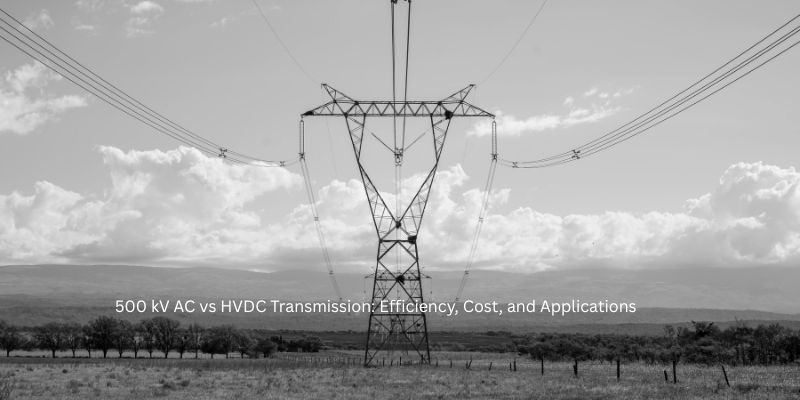
Key Technical Characteristics of ±500 kV HVDC:
- Nominal voltage: ±500 kV (bipolar, 1000 kV total pole-to-pole)
- Frequency: Not applicable (DC system)
- Typical power transfer capacity: 2,000 to 3,000 MW per bipolar line
- Economical distance: 600 to 1,500 km (most economical beyond 800 km)
- Number of conductors: 2 poles (positive and negative)
- Converter stations required: One at each end (rectifier and inverter)
500 kV AC vs HVDC: Complete Comparison Table
Efficiency Comparison: Why HVDC Wins for Long Distances
500 kV AC Loss Components:
- Resistive loss (I²R): 3-5% per 1,000 km
- Corona loss: 0.5-2% during foul weather
- Reactive power loss: Significant (requires compensation)
- Dielectric loss: Small but present
- Total losses at 1,000 km: 10-15%
±500 kV HVDC Loss Components:
- Resistive loss (I²R): 2-3% per 1,000 km
- Converter station loss (each end): 1-1.5% per station
- Corona loss: Lower than AC (DC corona has a higher threshold)
- Total losses at 1,000 km: 4-6% (including both converter stations)
💡 Key Insight: For a 1,000 km transmission line, HVDC saves approximately 5-8% of power that would otherwise be lost in an AC system. Over a 25-year project life, this translates to millions of dollars in recovered energy.
Cost Analysis: Initial Investment vs Long-term Economics
Initial Capital Cost Breakdown:
- 500 kV AC: Lower terminal cost, moderate line cost. Total project cost for 300 km: $80-150 million
- ±500 kV HVDC: Higher terminal cost (converter stations are expensive), similar line cost. Total project cost for 300 km: $120-200 million
Break-even Distance Calculation:
The crossover point where total HVDC cost equals AC cost is typically 600-800 km for overhead lines. For subsea cables, the break-even distance drops to 50-80 km due to AC cable charging current limitations.
Life Cycle Cost (25 years):
- 500 kV AC: Lower initial cost but higher operating losses. Maintenance moderate.
- ±500 kV HVDC: Higher initial cost but significantly lower losses. Lower maintenance (fewer moving parts), but converter station maintenance requires specialized expertise.
💰 Cost Example: For a 1,000 km, 2,000 MW transmission project, HVDC may cost $50-100 million more upfront but saves $200-300 million in losses over 25 years.
Applications: When to Use Each Technology
Best Applications for 500 kV AC:
- Regional power transmission within a synchronous grid (200-500 km)
- Connecting power plants to load centers in the same frequency area
- Grid expansion and reinforcement in existing AC networks
- Areas requiring multiple intermediate tapping points
- Lower population density regions with available right-of-way
- Short subsea crossings (less than 50 km)
Best Applications for ±500 kV HVDC:
- Long-distance bulk power transmission (600+ km)
- Connecting remote hydroelectric, wind, or solar farms to distant load centers
- Subsea and underground cables of any length
- Interconnecting asynchronous grids (different frequencies or phase angles)
- Power transmission through densely populated areas (narrower ROW)
- Offshore wind farm integration
- Back-to-back HVDC for grid stabilization and power flow control
Real-World Project Examples
Notable 500 kV AC Projects:
- California ISO (USA): Extensive 500 kV network interconnecting the state
- Indian National Grid: 400 kV and 765 kV network (500 kV used in some regions)
- China Southern Power Grid: 500 kV AC ring around major industrial centers
- Brazil: 500 kV AC network connecting Amazon hydro to southern load centers (with series compensation)
Notable ±500 kV HVDC Projects:
- Pacific DC Intertie (USA): ±500 kV, 1,360 km, 3,100 MW — operational since 1970, upgraded several times
- NorNed (Norway to Netherlands): ±500 kV, 580 km subsea cable, 700 MW
- Basslink (Australia): ±400 kV (near 500 kV), 370 km subsea + 290 km overhead
- India – Sri Lanka Interconnector: Planned ±500 kV HVDC
- Quebec – New England (Phase II): ±450 kV HVDC
Advantages and Disadvantages Summary
✓ 500 kV AC Advantages
- Lower terminal station cost
- Simple and economical line tapping
- Mature technology with extensive operational experience
- AC transformers are standardized and reliable
- Direct connection to AC loads and generators
- Established maintenance procedures and workforce
✗ 500 kV AC Disadvantages
- Higher losses over long distances
- Requires reactive power compensation (shunt reactors, series capacitors)
- Skin effect reduces conductor utilization
- Stability issues and angular limits over very long lines
- Wider right-of-way requirement
- Limited subsea cable length (charging current)
✓ ±500 kV HVDC Advantages
- Lower losses over long distances (5-10% better)
- No reactive power compensation along the line
- No skin effect — full conductor utilization
- Narrower right-of-way (reduces land acquisition cost)
- Connects asynchronous grids (different frequencies)
- Excellent for subsea and underground cables of any length
- Fast power flow control and grid stabilization
✗ ±500 kV HVDC Disadvantages
- Higher terminal cost (converter stations are expensive)
- Tapping the line is complex and costly
- Requires harmonic filters and reactive power support at terminals
- Converter stations produce audible noise
- Specialized maintenance and trained personnel are required
- Less mature than AC (though rapidly evolving)
Environmental Impact Comparison
- Land use: HVDC requires 30-50% narrower right-of-way, reducing land clearing and habitat fragmentation.
- Electromagnetic fields (EMF): HVDC produces lower EMF levels compared to AC, potentially beneficial near populated areas.
- Audible noise: AC lines have higher corona noise during foul weather. HVDC converter stations produce noise, but lines are quieter.
- Visual impact: HVDC towers are often more compact. Both require tall structures visible from a distance.
- Subsea impact: HVDC cables do not require reactive compensation stations offshore, reducing marine environmental footprint.
Future Trends in High-Voltage Transmission
- Voltage Source Converter (VSC) HVDC: Newer technology with black-start capability, compact design, and lower harmonic content
- UHVDC (800 kV, 1100 kV): China is operating ±1100 kV for 3,000+ km transmission with 12 GW capacity
- Multi-terminal HVDC grids: Future supergrids connecting multiple countries and offshore wind farms
- Hybrid systems: AC for regional distribution, HVDC for backbone long-distance corridors
- High-temperature low-sag (HTLS) conductors: Uprating existing AC lines to increase capacity
- Gas-insulated lines (GIL): For underground transmission in urban areas
Conclusion: Which One Should You Choose?
The selection between 500 kV AC and ±500 kV HVDC depends primarily on transmission distance, project scale, and specific technical requirements:
- Choose 500 kV AC when:
- Transmission distance is less than 500 km
- Multiple intermediate tapping points are required
- Expanding an existing synchronous AC grid
- Lower initial capital cost is critical (short to medium term)
- Choose ±500 kV HVDC when:
- Transmission distance exceeds 600 km
- Subsea or underground cable is required
- Connecting two asynchronous grids (different frequencies)
- A narrower right-of-way is needed (densely populated areas)
- Long-term operational efficiency and lower losses are priorities
For most new long-distance bulk power transmission projects — particularly those connecting remote renewable energy sources to urban load centers — HVDC is increasingly becoming the preferred choice due to its superior efficiency, narrower environmental footprint, and better long-term economics despite higher initial terminal costs.
📢 Found this comparison helpful? Share it with power system engineers and project planners.
🔗 Explore more technical articles at MadinaConTech.com
📌 Related: Sourcing Transformers from China | 220 kV Transmission Line Guide
Frequently Asked Questions (FAQ)
What is the break-even distance for HVDC vs AC?
The typical break-even distance is 600-800 km for overhead lines. For subsea cables, it drops to 50-80 km due to AC cable charging current limitations.
Is HVDC more efficient than AC?
For long distances (above 600 km), yes. HVDC efficiency is 95-97% at 1,000 km compared to 85-90% for AC at the same distance.
Why is HVDC not used for all transmission lines?
Because converter stations are very expensive ($150-300 million per station). For short distances (under 500 km), AC is more economical overall.
Can HVDC connect two different frequency grids?
Yes. This is one of HVDC’s key advantages — it can connect asynchronous grids (e.g., 50 Hz and 60 Hz) without synchronization issues.
What is the longest HVDC line in the world?
China’s ±800 kV UHVDC from Xinjiang to Anhui is approximately 3,300 km long with 12 GW capacity. For ±500 kV, the Pacific DC Intertie (1,360 km) is among the longest.
Which has lower maintenance cost, AC or HVDC?
HVDC lines have lower maintenance costs (fewer moving parts, no reactive compensation devices). However, HVDC converter stations require specialized, more expensive maintenance compared to AC substations.
Are HVDC lines safe for humans living nearby?
Yes. HVDC lines produce lower electromagnetic fields than AC lines of comparable voltage. Both are safe when proper clearances (as per NESC/IEC) are maintained.
© 2026 MadinaConTech — Professional resources for electrical power professionals. | #500kVAC #HVDC #PowerTransmission