
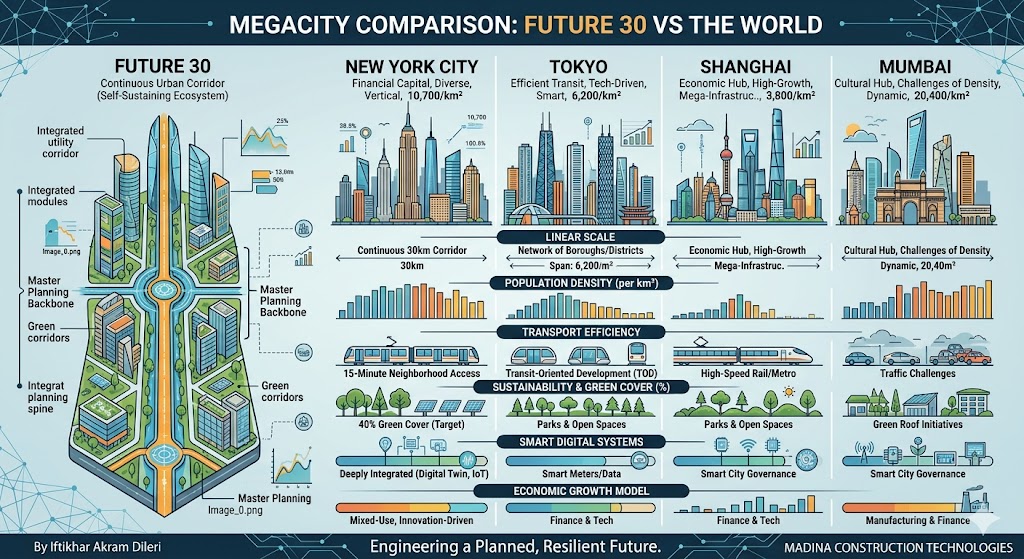
Megacity Comparison: Future 30 vs The World
Every city tells a story. Tokyo moves millions with mechanical precision. Dubai builds impossible towers in the desert. Singapore turns every drop of water into a national treasure. NEOM dreams of a car-free linear future.
Paris is reinventing itself as the fifteen-minute city. Islamabad grew from a clean master plan in the 1960s. Washington DC wields power and monumental architecture. And then there is Future 30 — a clean-sheet megacity blueprint designed to learn from all of them.
Tokyo: The Giant That Works
Thirty-seven million people live in Tokyo’s metro area — more than the entire population of Canada. Yet the city runs on time. The train network moves eight billion passengers a year with average delays of less than thirty seconds. Crime is low. Streets are clean.
But Tokyo has limits. The city grew organically over centuries. Housing is famously small. Green space is scarce. The population is aging and slowly shrinking.
What Future 30 learns from Tokyo: Discipline, punctuality, and respect for public space. But Future 30 starts with twice the green cover and homes designed for families.
Dubai: The Vertical Ambition
In fifty years, Dubai went from a desert trading post to a global hub. The Burj Khalifa pierces the sky at 828 meters. Artificial islands reshape the coastline. Dubai does not ask if something can be done — it asks how fast.
Yet Dubai’s model has cracks. The city is almost entirely car-dependent. Summer temperatures reach fifty degrees. The population is ninety percent foreign, temporary workers, not permanent communities.
What Future 30 learns from Dubai: Ambition and speed. But Future 30 prioritizes walkability, passive cooling, and community stability.
Singapore: The Garden in the Machine
Singapore is the gold standard of urban planning. Every tree is registered. Every drop of water is recycled. Public housing houses eighty percent of the population — and it is desirable housing, not ghettos.
But Singapore is small — just 733 square kilometers. The cost of living is among the highest in the world. A car costs over a hundred thousand dollars just for a license.
What Future 30 learns from Singapore: Water recycling, green integration, and the value of public housing. But Future 30 scales these lessons to thirty linear kilometers with lower entry costs.
NEOM and The Line
NEOM is Saudi Arabia’s five-hundred-billion-dollar bet on a post-oil future. The Line is two hundred kilometers of mirrored walls, just two hundred meters wide, housing nine million people. No cars, no roads, no carbon emissions.
But The Line is not yet real. Engineers question the feasibility. How do you evacuate nine million people during an emergency? How does natural light reach the lower levels?
What Future 30 shares with NEOM: The linear concept and car-free ambition. But Future 30 is thirty kilometers — a manageable scale with proven technologies.
Paris: The Fifteen-Minute Revolution
Paris is more than two thousand years old. But it is reinventing itself. The “fifteen-minute city” concept means every Parisian lives within a quarter-hour walk of everything they need — school, work, groceries, parks, and clinics.
Yet Paris fights its own history. The city was not designed for this. The metro is aging. Housing is scarce. The suburbs remain disconnected.
What Future 30 learns from Paris: The fifteen-minute neighborhood is built into the blueprint from day one. No retrofitting needed.
Islamabad: The Master-Planned Capital
Islamabad is a rare success story in South Asian urbanism. Built from scratch in the 1960s, the city is organized into clean grids — sectors labeled from F-1 to I-10. Green belts separate neighborhoods. Wide roads and abundant parks keep the city livable.
But Islamabad has outgrown its original plan. Public transport remains weak. The city is car-dependent. Walking is pleasant in the sectors, but impractical for daily commuting.
What Future 30 learns from Islamabad: The value of a clean start and clear sector zoning. But Future 30 builds in adaptive capacity — five-year reviews and density triggers.
Washington DC: Power and Gridlock
Washington DC is the capital of the world’s most powerful nation. The National Mall, the Capitol, the White House — designed to impress. Wide avenues, roundabouts, and sightlines define the city.
But DC has contrasts. Wealthy neighborhoods sit blocks from struggling wards. The Metro has aging infrastructure. Traffic is legendary. The Capital Beltway is a permanent parking lot during rush hour.
What Future 30 learns from Washington DC: The importance of civic grandeur and public space. But Future 30 avoids political entanglements with a dedicated development authority.
Side by Side: The Numbers
| Metric | Tokyo | Dubai | Singapore | NEOM | Paris | Islamabad | Washington DC | Future 30 |
|---|---|---|---|---|---|---|---|---|
| Population (millions) | 37 | 3.5 | 5.6 | 9 | 12 | 2.3 | 6.3 | 2-4 |
| Green cover % | 12% | 8% | 47% | — | 20% | 25% | 20% | 40% |
| Avg commute (minutes) | 48 | 45 | 42 | 5 | 38 | 55 | 43 | 25 |
| Water recycling % | 30% | 40% | 100% | 100% | 25% | 15% | 20% | 100% |
| Renewable energy % | 22% | 15% | 4% | 100% | 23% | 35% | 12% | 100% |
| Walk Score | 85 | 45 | 70 | 95+ | 88 | 40 | 75 | 92 |
| Affordable housing % | 40% | 20% | 80% | — | 25% | 35% | 30% | 15% |
Who Wins Each Category?
No city moves more people more smoothly. Future 30 aims to beat Tokyo by building transport capacity for fifty percent higher than the initial demand.
Forty-seven percent green cover is extraordinary. Future 30 targets forty percent from day one with vertical forests and green corridors.
Paris’s fifteen-minute city is a beautiful retrofit. Future 30 was born as a fifteen-minute city with every home within easy walking distance of daily needs.
Singapore already recycles all its water. Future 30 matches this while adding sponge city elements that Singapore cannot accommodate.
Both aim for one hundred percent renewables. Future 30’s thirty-kilometer scale is more achievable than NEOM’s two hundred kilometers.
Eighty percent of Singaporeans live in government-built housing. Future 30 dedicates fifteen percent of units to low-income families.
What Future 30 Does Better
- Clean-sheet integration — Every system is designed together, not layered over centuries.
- Thirty-kilometer focus — Long enough to be a megacity, short enough to be manageable.
- Adaptive master planning — Built-in five-year reviews and density triggers.
- Sponge city from day one — Permeable pavements, rain gardens, and cisterns from the start.
- Neuro-aesthetic architecture — Designed for human psychology, not just efficiency.
- Zero landfill waste — All waste recycled or converted to energy.
- Carbon negative by year five — Solar, afforestation, and waste-to-energy make the city a net carbon sink.
What Each City Can Teach Future 30
Tokyo teaches that punctuality and discipline are non-negotiable. When a train is delayed by thirty seconds, the driver apologizes. That level of respect for time is rare. Future 30 will embed that same discipline into its transport culture.
Dubai teaches that speed matters. Projects that take decades elsewhere rise in years. The lesson is not to cut corners but to cut bureaucracy. Future 30’s development authority will have single-window clearance for all permits.
Singapore teaches that water is sacred. Every drop is measured, cleaned, and reused. Future 30 will have the same obsession — not just with water, but with every resource.
NEOM teaches that audacity inspires. Even if The Line never fully works, it has changed how the world thinks about cities. Future 30 thanks NEOM for that courage.
Paris teaches that old cities can learn new tricks. If Paris can retrofit itself for walking and cycling, a new city has no excuse. Future 30 will be walkable from day one.
Islamabad teaches that master plans work — but only if they evolve. A plan is not a prison. Future 30 will review its blueprint every five years and adjust.
Washington DC teaches that public spaces should inspire. The National Mall makes you feel small in a good way. Future 30 will have grand plazas and gathering spaces that remind residents they are part of something larger.
What Future 30 Avoids
Future 30 avoids Tokyo’s cramped housing. Every home in Future 30 meets international size standards with room for families to grow.
Future 30 avoids Dubai’s car dependency. Sixty percent of streets are car-free. Walking and cycling are the default, not an afterthought.
Future 30 avoids Singapore’s cost barrier. While Singapore is a playground for the wealthy, Future 30 reserves fifteen percent of all housing for low and middle-income families.
Future 30 avoids NEOM’s feasibility gamble. Every technology in Future 30 is proven at scale. No experiments with unproven systems.
Future 30 avoids Paris’s retrofitting pain. The fifteen-minute neighborhood is baked in, not bolted on.
Future 30 avoids Islamabad’s transport gap. A multimodal system — LRT, BRT, e-scooters — connects everything before the first resident moves in.
Future 30 avoids Washington DC’s gridlock. Adaptive traffic signals, congestion pricing, and abundant public transit mean no permanent parking lots called highways.
The Verdict
Tokyo proves that scale can work. Dubai proves that speed can transform. Singapore proves that planning can deliver paradise. NEOM proves that audacity still exists. Paris proves that old cities can learn new tricks. Islamabad proves that South Asia can do master planning. Washington DC proves that power needs a worthy stage.
But every city has limits. Tokyo cannot reinvent its housing stock. Dubai cannot cool its streets. Singapore cannot grow its land area. NEOM cannot guarantee its feasibility. Paris cannot erase its history. Islamabad cannot stop its sprawl. Washington DC cannot escape its traffic.
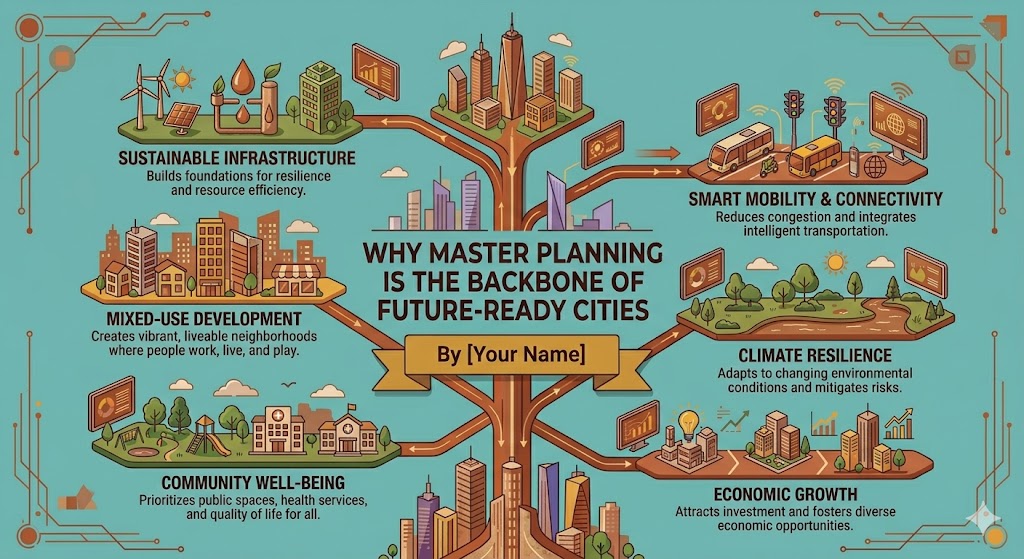
Future 30 is not here to replace these cities. It is here to learn from them — and then go further. It takes Tokyo’s discipline, Dubai’s speed, Singapore’s water wisdom, NEOM’s audacity, Paris’s human scale, Islamabad’s zoning clarity, and Washington’s civic grandeur. Then it adds integrated utility corridors, neuro-aesthetic design, sponge city hydrology, and carbon-negative energy.
The world does not need another copy of Tokyo or Dubai. The world needs a city that synthesizes its best lessons into something new. That city is Future 30.
1. Future 30 · 2. Singapore · 3. Tokyo · 4. Paris · 5. NEOM · 6. Washington DC · 7. Islamabad · 8. Dubai
Paris, France — The City of Light
Paris is not just a city; it is a feeling. The Eiffel Tower sparkling at midnight, the Seine River winding through historic neighborhoods, and the aroma of fresh croissants from corner bakeries. Every street feels like a painting. Every café tells a story. Paris teaches us that beauty lives in details — wrought iron balconies, cobblestone lanes, and golden hour light over the Louvre.
Venice, Italy — The Floating Masterpiece
Venice has no roads, only canals. Gondolas glide under ancient bridges. Palaces rise directly from the water. St. Mark’s Square glows at sunrise. Venice is fragile and magnificent — a reminder that the most beautiful things often require the most care. Getting lost here is not a mistake. It is the whole point.
Kyoto, Japan — The Soul of Tradition
Kyoto moves at a different rhythm. Cherry blossoms in spring. Maple leaves in autumn. Golden temples reflected in still ponds. Geishas walk quietly through the Gion district. Kyoto does not shout for attention. It whispers elegance. Every garden, every tea house, every wooden bridge is designed for peace. This is beauty as meditation.
Cape Town, South Africa — Where Mountain Meets Ocean
Cape Town sits at the edge of two oceans. Table Mountain towers above the city like a guardian. White sand beaches stretch for miles. Vineyards cover the valleys. Cape Town is wild beauty — dramatic, colorful, and full of energy. From Boulders Beach with its penguins to the colorful houses of Bo-Kaap, every corner surprises.
Santorini, Greece — The Blue and White Dream
Santorini is the postcard that became real. Whitewashed buildings with blue domes perched on volcanic cliffs. Sunsets that turn the sea into liquid gold. Narrow paths lined with bougainvillea. Santorini is small but mighty. It proves that a single island can hold enough beauty for a lifetime.
Prague, Czech Republic — The Fairytale City
Prague looks like a storybook. Gothic spires, medieval bridges, and castle walls that have watched over the city for a thousand years. Charles Bridge at dawn, with mist rising from the Vltava River. Old Town Square with its astronomical clock. Prague is timeless — old enough to feel ancient, young enough to feel alive.
Istanbul, Turkey — Where East Meets West
Istanbul straddles two continents. The Hagia Sophia and Blue Mosque face each other across a park. The Bosphorus Strait shimmers between Europe and Asia. Spice markets, call to prayer, and the smell of fresh bread from street vendors. Istanbul is chaotic, colorful, and completely captivating. Beauty here is loud, proud, and unforgettable.
Queenstown, New Zealand — The Adventure Paradise
Queenstown is nature at its most dramatic. Snow-capped mountains plunge into crystal-clear lakes. Pine forests cover the hillsides. The sky at night is scattered with more stars than you have ever seen. Queenstown is for those who find beauty in wild places — where the air is clean, and the views leave you speechless.
Romance & Light
Canals & Dreams
Tradition & Peace
Mountain & Ocean
Sunset & Sea
Why These Cities Capture Our Hearts
Beautiful cities are not just about architecture or landscapes. They are about how they make us feel. Paris feels like love. Venice feels like a mystery. Kyoto feels calm. Cape Town feels like freedom. Santorini feels like a dream. Prague feels like history. Istanbul feels like an adventure. Queenstown feels like awe.
Each city offers something unique, but all of them share one thing — they stop time. When you stand on a bridge in Venice at sunset, or watch the Eiffel Tower sparkle after dark, or see the cherry blossoms fall in Kyoto, you forget your phone. You forget your worries. You just exist in that moment. That is the power of beautiful cities.
Which City Will You Visit First?
Every traveler has a different answer. Some want the romance of Paris. Others want the canals of Venice. Some seek the peace of Kyoto. Others chase the sunset in Santorini. There is no wrong choice. The world is full of beautiful cities. Each one is waiting for you.
Pack your bags. Book the ticket. Go find your favorite. And when you do, share it with the world — on Instagram, TikTok, Facebook, or just in a quiet conversation with someone you love.
Most Beautiful Cities in the World — Travel Guide 2026
Conclusion
No single city wins every category. Singapore owns water. Tokyo has transport. Paris owns walkability. Dubai has ambition. Islamabad owns sector clarity. Washington owns civic grandeur. NEOM owns audacity.
But Future 30 owns integration — the ability to weave all these lessons into a single, coherent, buildable blueprint. The future of urbanism is not about copying. It is about synthesizing. And that is exactly what Future 30 does.
The question is not whether such a city can be built. The question is whether we have the will to build it. The technology exists. The capital exists. The lessons from seven global cities are on the table. All that remains is action.
Future 30 is a blueprint, not a fantasy. It is ready. The only missing ingredient is collective will.