
Construction technology is changing how we build. From AI and BIM to smart jobsite wearables, modern tools help contractors cut delays, lower costs, and solve labor shortages. Here are the top 10 technologies shaping jobsites today.
- Commercial construction software ROI
- Enterprise BIM software pricing
- AI construction management platform
- Modular construction tech cost
- Prefabricated building systems vendor
- Digital twin infrastructure solutions
- Industrial robotics for contractors
- Automated layout robot for sale
- Cloud common data environment
- Smart jobsite safety wearables
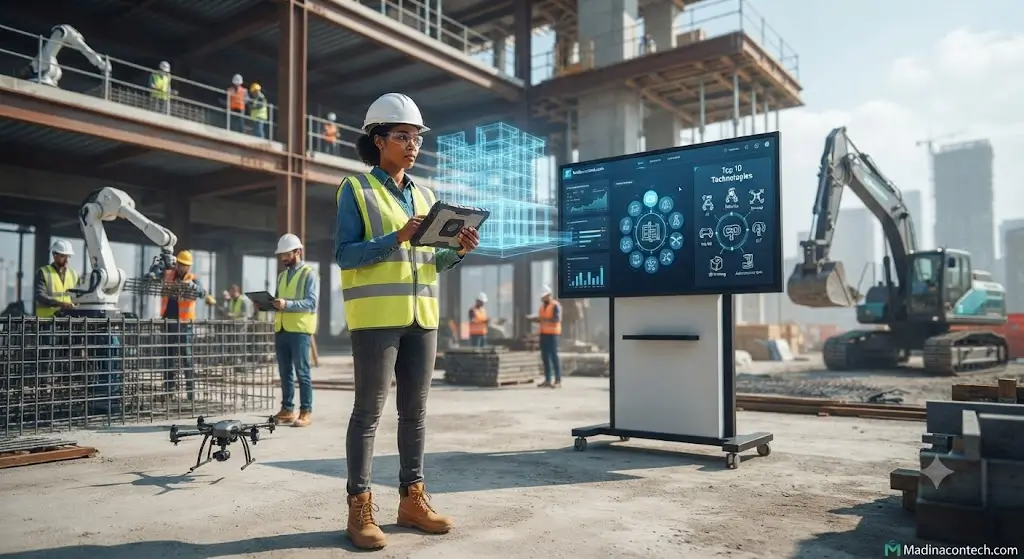
🏗️ Top 10 Construction Technologies Shaping Modern Jobsites
By Madina Contech Team •
Updated: July 2026 • 7 min read
🚧 The construction industry is undergoing a massive shift. What once felt like a purely traditional, paper-heavy field is rapidly modernizing. With tight labor markets, squeezed profit margins, and increasingly complex building designs, technology is no longer just a luxury—it’s how successful projects cross the finish line.
Whether you’re a site supervisor, project manager, or contractor in Pakistan, the Middle East, or beyond, embracing these top 10 construction technologies isn’t optional anymore—it’s survival. In this article, we break down the innovations that are boosting productivity, cutting costs, and saving lives on modern job sites.
👉 Bookmark this page and share it with your team. And if you’re looking for expert construction services in Pakistan, we’ve got you covered.
📌 Related: 10 Essential Construction Tips for New Builders
📑 Quick Navigation
- 1. AI & Predictive Analytics
- 2. Advanced BIM
- 3. Augmented Reality (AR)
- 4. Digital Twins
- 5. Jobsite Automation
- 6. Drones & Reality Capture
- 7. Cloud CDE
- 8. Wearable Safety Tech
- 9. Carbon Estimating
- 10. Prefabrication & Modular
1. 🤖 Artificial Intelligence and Predictive Analytics
AI has moved well past the hype cycle and is now actively hardwired into day-to-day construction workflows. Instead of just reacting to problems, contractors are using AI-driven predictive analytics to forecast budget overruns, flag safety hazards before incidents occur, and manage material logistics. By feeding historical project data into machine learning models, project managers can spot bottlenecks early and make smarter decisions on the fly.
For example, AI can analyze weather patterns, labor productivity rates, and supply chain delays to predict with 85% accuracy whether a project will miss its deadline—weeks in advance. That gives teams the window to adjust schedules, bring in extra crews, or expedite materials.
#AIconstruction
#predictiveanalytics
#smartjobsites
🔗 External Link: Read more on RIB Software’s AI insights
📎 See how we use AI in our project management workflow
2. 🧊 Advanced Building Information Modeling (BIM)
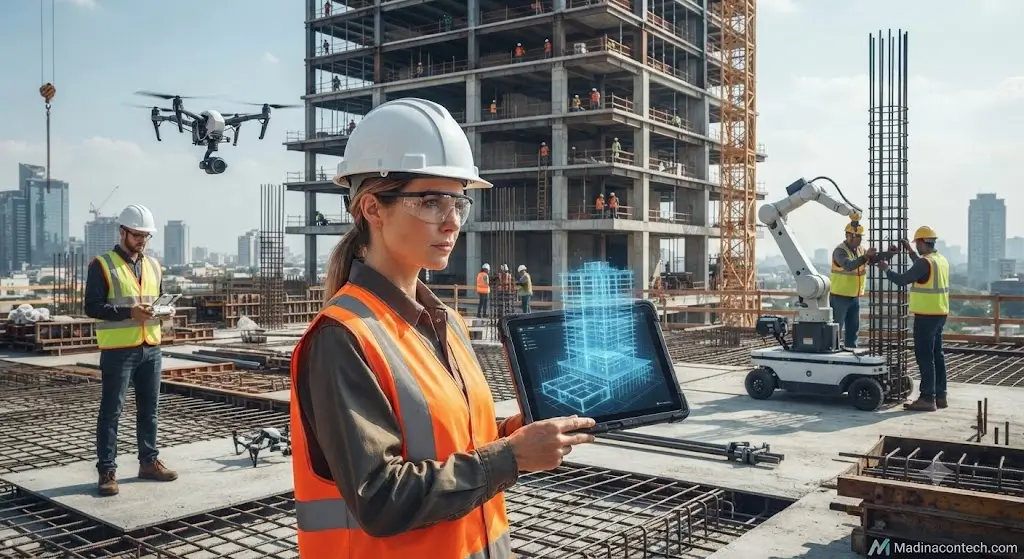
BIM has evolved far beyond a basic 3D drawing tool. Today, it acts as a collaborative, multi-dimensional ecosystem—incorporating time tracking with 4D BIM and cost estimation with 5D BIM—that connects the trailer to the field. Modern cloud-based BIM platforms ensure that architects, structural engineers, and site superintendents are all looking at a single source of truth, dramatically reducing costly clashes and rework on site.
In Pakistan, where large-scale infrastructure projects are booming, BIM adoption is accelerating. Government bodies are now mandating BIM for public tenders, making it a non-negotiable skill for local contractors.
#BIM
#4DBIM
#5DBIM
🔗 External Link: Explore Trimble’s BIM solutions
3. 🥽 Augmented Reality (AR) and Mixed Reality (MR)
Carrying bulky rolled-up drawings across a muddy jobsite is quickly becoming a thing of the past. With AR headsets and tablet-based visualization tools, field crews can superimpose 3D BIM models directly onto the physical environment. This allows workers to check MEP (mechanical, electrical, and plumbing) placements inside concrete walls or verify structural alignments in real time, bridging the gap between digital design and physical execution.
Imagine pointing an iPad at a bare concrete slab and seeing exactly where every pipe, conduit, and anchor bolt should go—overlaid with millimeter precision. That’s the power of AR, and it’s slashing rework costs by up to 40% on early-adopter sites.
#augmentedreality
#mixedreality
#constructionAR
4. 🪞 Digital Twins
A digital twin takes a building model a step further by creating a living, breathing digital replica fueled by real-time IoT sensor data. Sensors embedded in materials, heavy machinery, and structural components feed data back to a centralized dashboard. This tech helps monitor structural health, optimize energy consumption during the build, and provides facility managers with a complete operational blueprint long after handover.
For high-rise projects in Karachi and Lahore, digital twins are becoming essential for tracking concrete curing temperatures, vibration levels during pile driving, and even wind load stresses. The result? Safer structures and fewer surprises during final inspections.
#digitaltwin
#IoTconstruction
#smartbuildings
🔗 External Link: Autodesk’s guide to Digital Twins
5. ⚙️ Jobsite Automation and Robotics
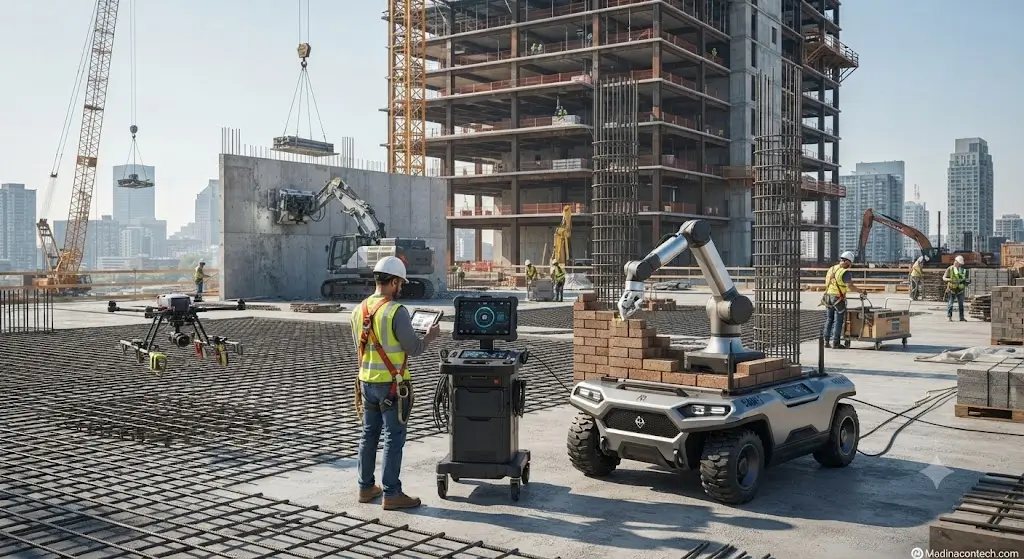
Faced with persistent skilled labor shortages, contractors are increasingly turning to automation to handle repetitive, heavy, or high-precision tasks. Semi-automated masonry (SAM) systems for bricklaying, remote-controlled demolition machines, and layout robots that physically print architectural grids directly onto concrete subfloors are becoming regular fixtures on advanced jobsites.
In Pakistan, where masonry work is still largely manual, early adopters of robotic bricklaying are reporting 3x faster wall construction with half the workforce. That’s not about replacing humans—it’s about augmenting them and reducing back-breaking labor.
#constructionrobotics
#automation
#SAMrobot
📎 Check our heavy equipment rental options for automated jobsites
6. 🛸 Drone Surveying and Reality Capture
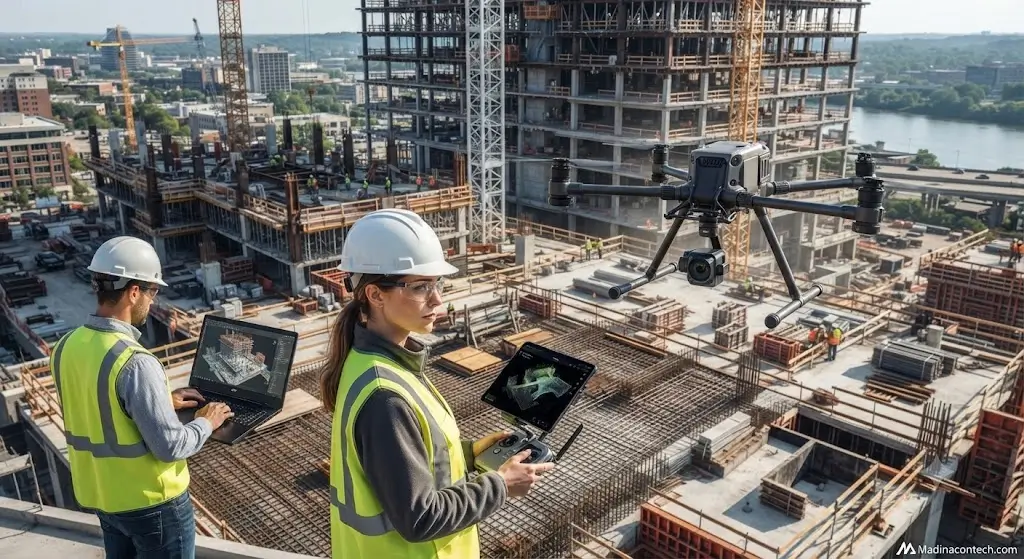
Site surveys that used to take days or weeks can now be completed in a matter of hours. Drones equipped with high-resolution cameras and LiDAR technology capture aerial maps, track daily or weekly progress, and monitor stockpile volumes with incredible precision. This aerial data feeds straight back into project management software to give stakeholders complete visibility without putting personnel in hazardous areas.
For large-scale infrastructure projects like the Diamer-Bhasha Dam or new motorway developments, drones are now standard issue. They provide real-time orthomosaic maps and 3D terrain models that help engineers make faster earthwork decisions.
#dronesurvey
#LiDAR
#realitycapture
7. ☁️ Cloud-Based Common Data Environments (CDE)
Fragmented communication is one of the biggest drains on construction productivity. Cloud-connected software platforms tie the entire project lifecycle together—linking estimating, field reporting, submittals, and accounting. Mobile-first field apps allow supers and foremen to log daily reports, request RFIs, and update schedules instantly from their phones or tablets, keeping the office and the field perfectly synchronized.
In a country like Pakistan, where site offices often lack stable internet, offline-first mobile apps with cloud sync have been a game-changer. Teams can work in remote areas and sync data when connectivity returns—no lost information, no double entry.
#cloudCDE
#constructionsoftware
#fieldreporting
🔗 External Link: Trimble’s project management ecosystem
8. 🦺 Wearable Safety and IoT Tech
Jobsite safety is getting a high-tech upgrade through connected wearables. Smart hard hats, biometric wristbands, and smart boots can monitor worker fatigue, track real-time locations during an emergency, alert workers to environmental hazards like extreme heat, and detect falls. It’s a proactive shift toward preventing accidents rather than just reacting to them.
With Pakistan’s extreme summer temperatures (often exceeding 45°C), heat-stress wearables are saving lives. These devices alert supervisors when a worker’s core temperature or heart rate crosses dangerous thresholds, allowing for timely hydration breaks and medical checks.
#wearabletech
#jobsitesafety
#IoTsafety
📎 Our comprehensive safety training programs
9. 🌱 Carbon Estimating and Sustainable Tech
With owners and public entities facing stricter environmental regulations, tracking a project’s carbon footprint has become a major priority. Modern carbon estimating tools integrate directly with BIM systems to evaluate the embodied carbon of building materials during the design phase. This allows teams to swap out carbon-heavy elements for sustainable alternatives—like low-carbon concrete or smart insulation—without sacrificing structural integrity.
The Pakistan Green Building Council is now offering certification incentives for projects that reduce embodied carbon by 20% or more. Forward-thinking developers are using carbon estimating early in the design stage to qualify for these ratings and attract eco-conscious buyers.
#carbonestimating
#sustainableconstruction
#greenbuilding
10. 🏭 Prefabrication and Modular Construction Tech
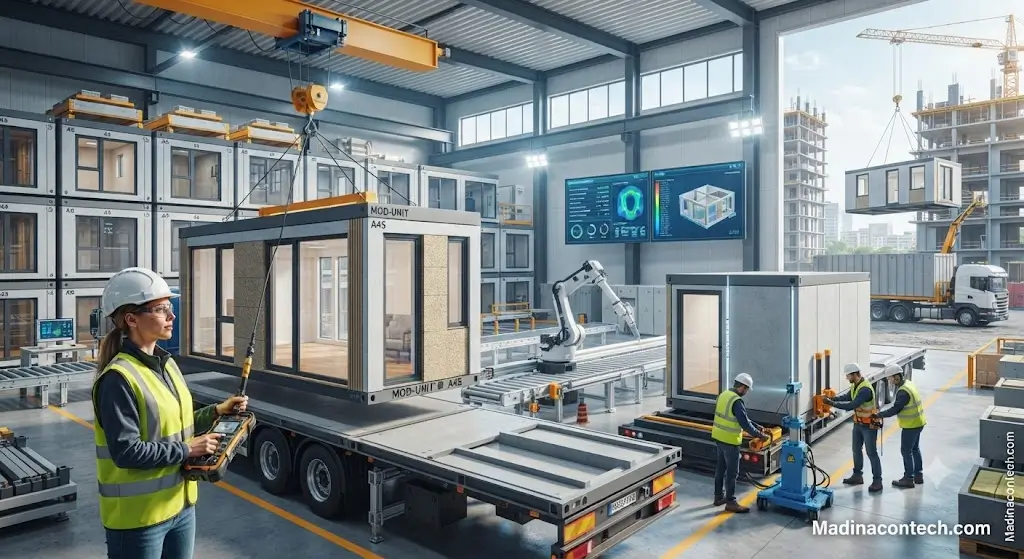
Factory-controlled construction is booming as a solution to timeline pressures and material waste. By building entire volumetric modules or structural components off-site in controlled warehouse environments, project teams can ensure tighter quality control, minimize weather-related delays, and drastically reduce the amount of labor required on the main jobsite.
In Pakistan, modular construction is gaining traction for housing schemes and hotel projects. Companies are now producing ready-to-install bathroom pods, MEP racks, and even full-room modules that can be craned into place in hours rather than weeks.
#prefab
#modularconstruction
#offsiteconstruction
📎 Explore our prefab and modular solutions
📊 Quick Comparison: Top 5 Tech by Impact
| Technology | Primary Benefit | Cost Impact | Adoption Difficulty |
|---|---|---|---|
| AI & Analytics | Risk prediction | ⬆️ High ROI | 🟡 Medium |
| BIM (4D/5D) | Clash detection | ⬆️ Very High ROI | 🟢 Low (with training) |
| Drones | Survey speed | ⬆️ High ROI | 🟢 Low |
| Wearables | Safety | ⬆️ Medium ROI | 🟢 Low |
| Prefab/Modular | Speed & quality | ⬆️⬆️ Very High ROI | 🟡 Medium |
Table note: ROI and difficulty are general estimates based on Pakistan and Middle East markets. Your mileage may vary.
🚀 Ready to bring these technologies to your next project?
At Madina
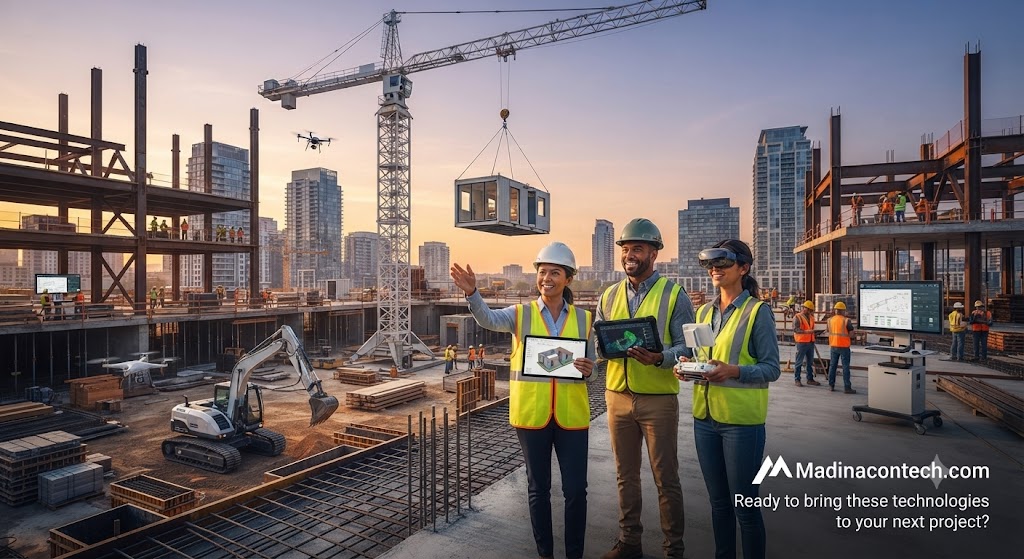
Contech, we specialize in integrating modern construction tech into local projects—from BIM coordination to drone surveying.
❓ Frequently Asked Questions
A: Most contractors see the fastest ROI from drone surveying and cloud-based CDE—both reduce rework and communication delays immediately. BIM also delivers quick wins if you’re doing clash detection.
A: Yes! Many AI tools now offer tiered pricing starting at $50–$100/month. You don’t need a data science team—just clean project data and a willingness to trust the algorithms.
A: Basic tablet-based AR apps require just 1–2 hours of training. Headsets like HoloLens take more time, but for most sites, a tablet is more than enough to visualize MEP and structural layouts.
A: They become an “as-built” operational manual. Facility managers use them to track maintenance schedules, energy usage, and even renovation planning—saving 15–25% on long-term operational costs.
A: Usually yes, for repetitive floor plans (hotels, apartments, hospitals). You save on labor, weather delays, and material waste. However, customization adds cost, so it’s best for standardized designs.
🔚 Final Thoughts
The construction industry is no longer “old school.” From AI-driven predictions to robotic bricklayers and digital twins, the tools available today are transforming how we design, build, and maintain our infrastructure. For contractors in Pakistan, the Middle East, and beyond, the question isn’t if you should adopt these technologies—it’s how fast.
At Madina Contech, we’re committed to helping you navigate this digital shift. Whether you need tech consulting, on-site training, or turnkey project execution, we’re just a call away.
👉 Which of these technologies are you most excited to try? Drop a comment below or reach out to our team—we’d love to hear from you!