
🧨 The battlefield has changed. In the lexicon of modern conflict, “warfare” has broken free from traditional physical boundaries. We are no longer just talking about boots on the ground or conventional hardware; we are living in the era of the tech war. When the stakes are raised to the absolute limit—safeguarding an atomic asset behind a complex, multi-layered defensive perimeter—traditional security protocols simply fall short.
What is the Tech War: Defending the Atom Bomb – Modern Engineering & Digital Defense
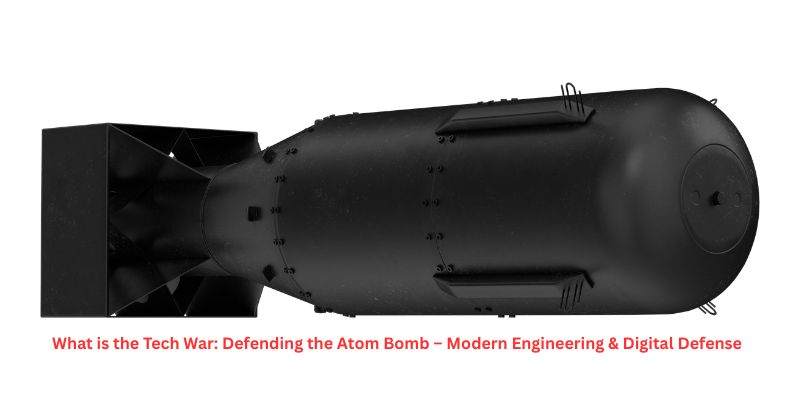
Defending a high-value strategic asset in the digital age requires a seamless fusion of physical infrastructure, structural engineering, and cutting-edge cyber-physical defenses. This guide breaks down the actual engineering and digital layers that protect the world’s most dangerous weapons.
📡 Navigate the Defense Layers (Internal Links)
1. The Red Blocks Wall: Micro-Engineering Meets Macro-Defense
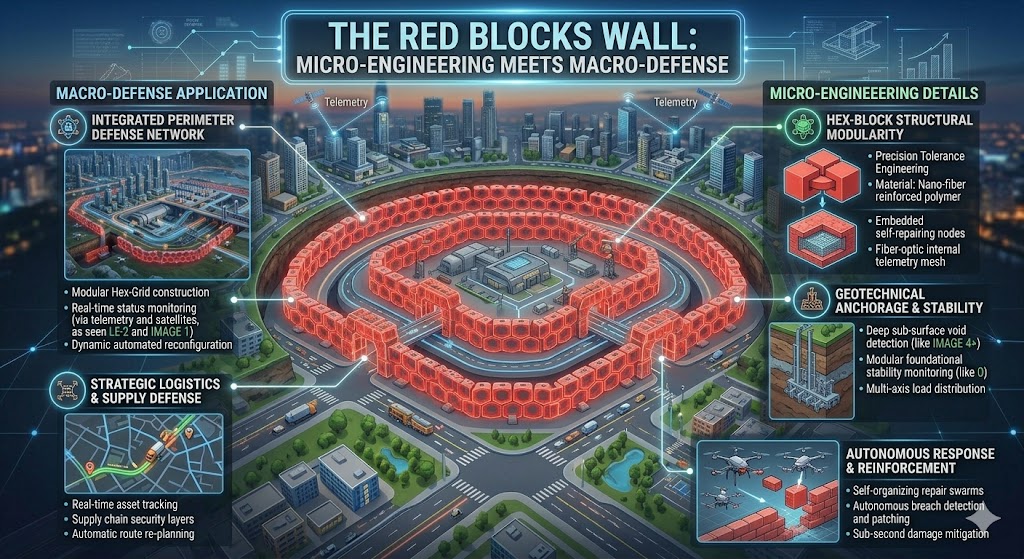
The “Red Blocks Wall” isn’t just a passive physical barrier; it represents a highly sophisticated, modular engineering matrix designed to isolate and protect critical assets from both kinetic and electronic threats. Unlike traditional concrete fortifications, this system thinks like an immune system.
Subsurface Resilience: Just as deep-underground infrastructure relies on precise structural modeling to withstand seismic events, the foundation of the Red Blocks Wall uses advanced geotechnical coordination to prevent breach attempts from beneath. Boring machines hit the reinforced tensor mesh—not soil.
Modular Redundancy: Built using a grid-based structural layout, if one “block” or section of the perimeter is compromised by an electronic or physical attack, the surrounding modules instantly isolate the zone. This prevents a localized failure from cascading into a total system breach. It’s the same principle used in modern server farms, but scaled to nuclear bunkers.
🔗 Related: See how this connects to real-time geospatial monitoring (section 2) for total awareness.
2. Integrated Geospatial & Structural Monitoring
To defend a weapon of mass destruction, situational awareness must be absolute. The modern defense framework merges macrogeospatial data with microfacility models in real time—what engineers call a digital twin.
Real-Time Threat Visualization: Using a synchronized digital twin of the facility, commanding officers can overlay live satellite data, aerial reconnaissance, and thermal mapping directly onto a high-fidelity 3D model of the bunker. If a drone swarm appears on the eastern ridge, the model updates instantly.
Predictive Vulnerability Analysis: By running constant simulations within this digital twin environment, AI defense protocols can identify structural weak points, predict blast radii, and dynamically reinforce defensive positions long before an actual assault occurs. The system doesn’t just react—it anticipates.
🌍 U.S. Army Research on Digital Twins in Battlefield Engineering
📡 Internal: Digital twin data feeds directly into dynamic logistics (section 3) to keep supply chains secure.
3. Dynamic Logistics & Supply Chain Defense
An atomic asset cannot be defended in isolation; it requires a continuous, highly secure flow of data, power, and physical resources. Managing these logistics safely under the threat of a high-tech adversary demands a dynamic approach to route planning.
Adaptive Route Optimization: Transporting critical components to and from the Red Blocks Wall requires live data integration. By analyzing real-time traffic flow, weather impacts, and active threat reports, logistics teams can instantly re-route supply convoys to avoid ambushes or electronic jamming zones.
Asset Tracking and Fleet Visibility: Every moving piece within the defensive network — from heavy transport vehicles to automated security drones — is tracked on a unified tactical dashboard. This ensures that operational constraints are met and delivery windows remain secure under tight schedules.
✅ All convoy routes have at least 3 real-time alternative paths.
✅ Each vehicle carries an air-gapped emergency beacon.
✅ Supply manifests are encrypted and split across multiple channels.
✅ Delivery windows are randomized to prevent pattern analysis.
🚚 Related: Fleet tracking integrates with air-gapped command protocols (section 4) to ensure no single point of digital failure.
4. Guarding the Digital Frontier: The Air-Gapped Paradox
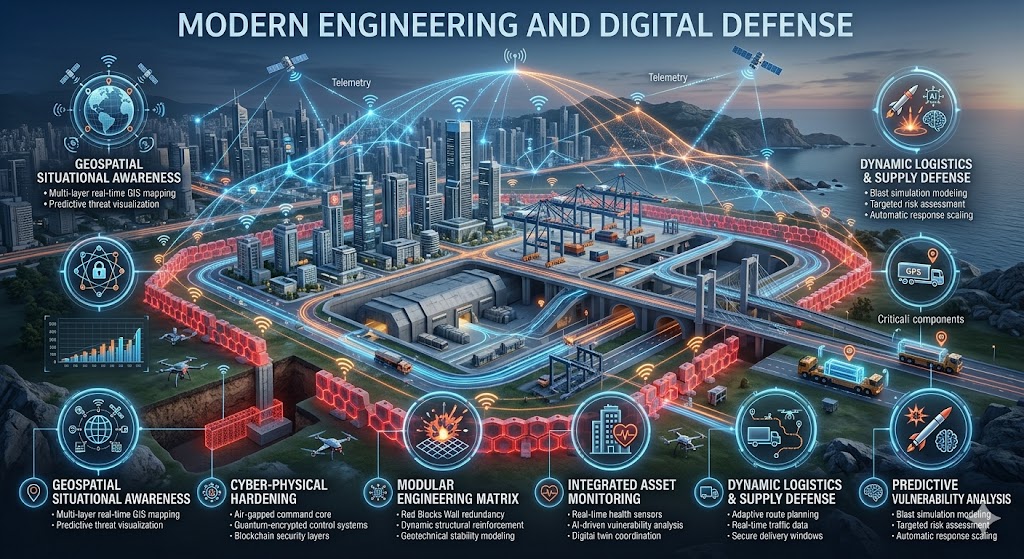
In a true tech war, the greatest threat to an atom bomb isn’t always a missile—it’s a line of code. Securing the asset means completely hardening the intersection where digital commands meet physical machinery.
The Air-Gapped Paradox: While the ultimate weapon must be completely isolated (air-gapped) from the public internet to prevent remote hacking, its defensive systems (the Red Blocks Wall, automated turrets, and sensor arrays) must remain interconnected to communicate effectively. How do you solve that?
Modern defense architectures employ unidirectional gateways—hardware devices that allow data to flow only one way (sensor data out, no commands in). This creates a “digital moat.” Even if an adversary penetrates the outer perimeter, they cannot send a single command to the core weapon systems.
🔐 National Defense Magazine – Air-Gapped Networks: Still Vulnerable?
🛡️ See also: The air gap is further reinforced by quantum encryption (section 5) for the data that does move.
5. Quantum Encryption & Decentralized Trust
Classical encryption can be broken eventually. Quantum encryption (quantum key distribution) changes the game entirely. Any attempt to intercept the key alters its quantum state, alerting defenders instantly.
Decentralized blockchain protocols are also entering the nuclear defense space — not for currency, but for verifiable, tamper-proof logs of every command, access request, and sensor reading. If one node is compromised, the distributed ledger rejects the false data.
In practice, this means that even if an adversary physically captures a guard station, they cannot forge a “launch” command without breaking the consensus of dozens of other independent nodes. The system doesn’t trust any single point.
🔬 National Quantum Coordination Office – Quantum Security Standards
6. The Human Factor: Where Engineering Meets Psychology
All the encryption and concrete in the world fail if a single human makes a mistake. The most sophisticated digital twin means nothing if an exhausted guard ignores an anomaly.
Behavioral monitoring now uses AI to detect unusual patterns in guard patrols, communication delays, or even keystroke rhythms. If a sentry begins acting outside their baseline — possibly due to coercion, fatigue, or a medical event — the system quietly alerts a supervisor.
Two-person rule 2.0: The classic nuclear “two-person” protocol is now augmented by biometric and geolocation verification. Both authorized individuals must be physically present, biometrically verified, and within a specific GPS-tagged zone before any critical command is accepted.
🧠 Internal link: Human factors directly impact future defense architectures (section 7), where AI assists but does not replace final human judgment.
7. The Future: Autonomous Response & Ethical Firewalls
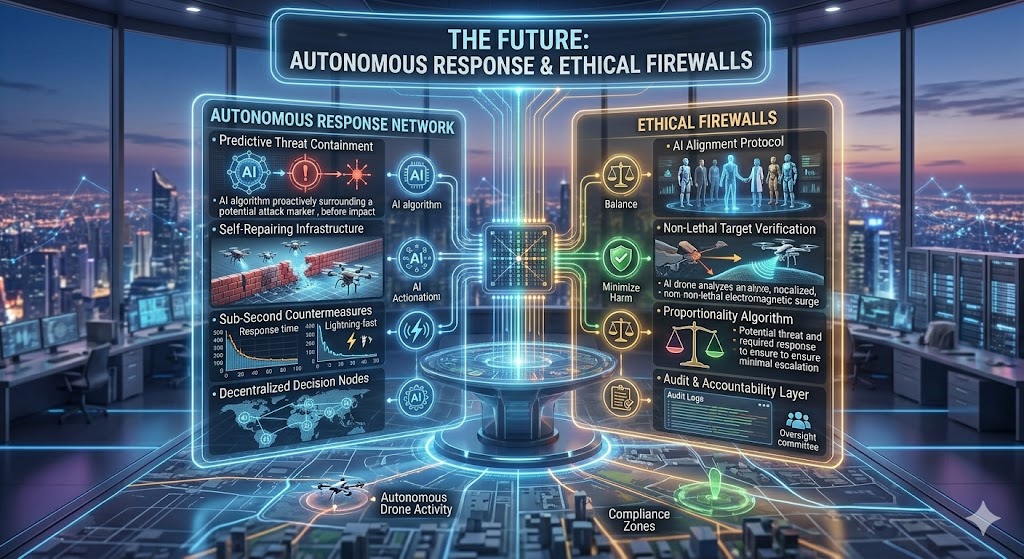
What happens when an AI detects an incoming hypersonic missile with 0.7 seconds to respond? The debate over autonomous defensive systems is no longer theoretical. Current doctrine insists on a “human in the loop” for nuclear assets—but reaction times are shrinking.
Ethical firewalls are being designed into next-gen defense systems: rules that an AI cannot override, such as requiring two independent sensor confirmations before escalating or automatically rejecting any order that originates from an unverified IP address.
The most likely near-term future is a supervised autonomy model: AI handles defensive logistics, threat prioritization, and damage assessment. But the final “authorize” command requires a human to insert a physical key — even if that key is now a biometric handprint read inside a Faraday cage.
🚀 Your Role in This Conversation
Understanding how engineering and cybersecurity merge to protect critical assets isn’t just for generals — it’s for engineers, architects, and digital builders who design the infrastructure of tomorrow.
Which of these 7 defense layers surprised you most? Share this article with your team or save it as a reference for high-security system design.
The Cost of Complacency: What History Teaches
We often assume that nuclear security is “solved.” But near-misses have happened due to sensor glitches, miscommunication, and even a $0.46 microchip failure. The 1979 NORAD false alarm (a training tape mistakenly loaded) and the 1983 Stanislav Petrov incident (a Soviet early warning system falsely indicating U.S. missiles) remind us that human judgment and redundant engineering are inseparable.
Today’s Tech War adds new dimensions: supply chain malware, deepfake voice commands, and drone swarms. The engineering solutions we’ve outlined—modular walls, digital twins, air-gapped architectures, and quantum encryption—are not luxuries. They are necessities.
🔁 Summary – The 7 Layers of Modern Nuclear Defense
1. Red Blocks Wall (modular engineering) •
2. Digital twin monitoring •
3. Dynamic logistics •
4. Air-gapped paradox solutions •
5. Quantum encryption & blockchain logs •
6. Human behavioral & biometric verification •
7. Supervised autonomy & ethical firewalls
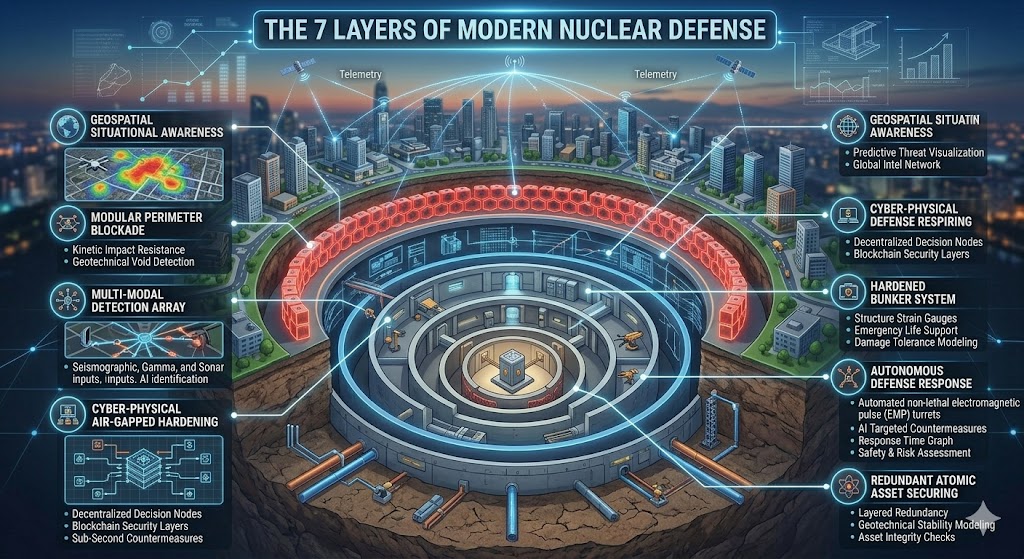
These layers don’t work in isolation. A breach in logistics (section 3) could lead to a compromised component that bypasses physical walls (section 1). A failure in human verification (Section 6) could override even the strongest air gap (Section 4). True defense is systemic—and that’s what modern tech war demands.